Singapore Business Visa

Offshore services
Bundled Services
Top Citizenship & Residency
Articles & Research
About Us
Contact Us


.svg)


Trusted by Global Clients & Partners


July 4, 2026
6
min read

Dominica vs St Kitts Citizenship 2026: Cost, Timeline, and Comparison

.svg)


2.2K

2.2K
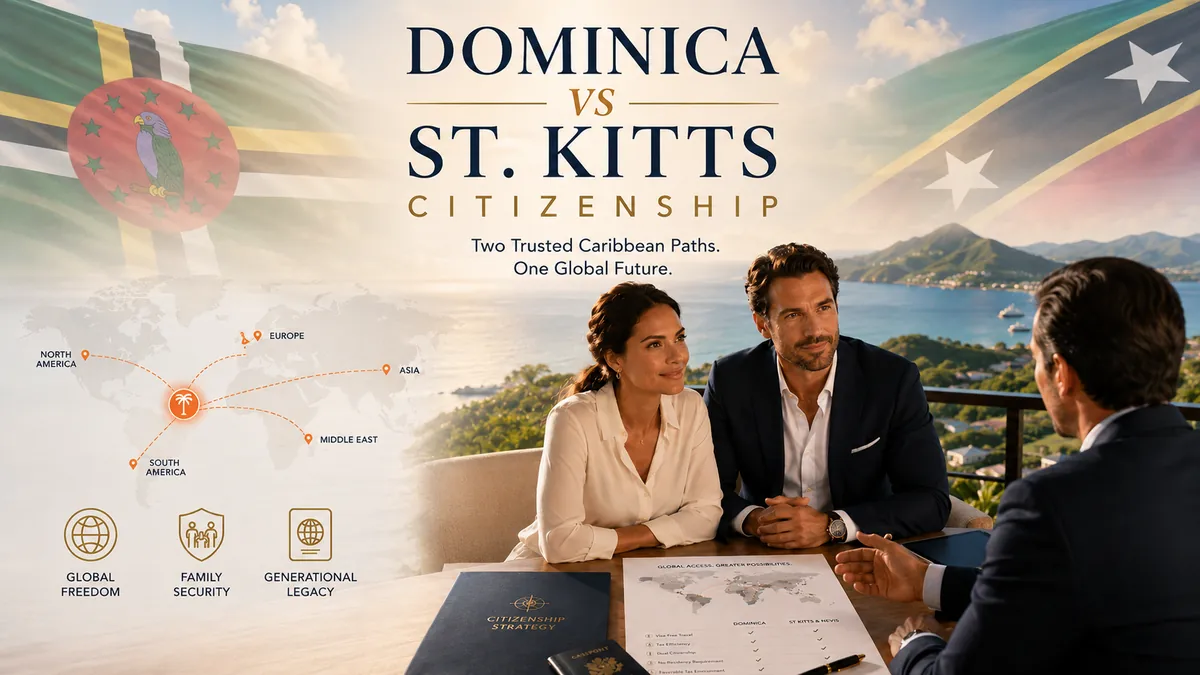
Dominica and St. Kitts and Nevis both offer OECS Caribbean citizenship by investment under the harmonized ECCIRA framework operational Q2 2026, but the two programs differ on cost (USD 200,000 vs USD 250,000 minimum), speed (6 to 9 months vs 4 to 6 months), passport strength (145 vs approximately 150 visa-free destinations), and US E-2 Treaty Investor Visa eligibility (St. Kitts only).
Key Takeaways
- Cost: Dominica CBI starts at USD 200,000 (Economic Diversification Fund donation) versus St. Kitts at USD 250,000 (Sustainable Island State Contribution). Single applicants save USD 50,000 with Dominica.
- Speed: St. Kitts processes in 4 to 6 months (fastest OECS program), Dominica processes in 6 to 9 months. Both operate under the same ECCIRA-harmonized due diligence standards.
- Passport strength: St. Kitts is marginally stronger (approximately 150 visa-free destinations, Henley Passport Index 2026) versus Dominica (145 destinations). St. Kitts also grants US E-2 Treaty Investor Visa eligibility; Dominica does not.
- Family inclusion: For families of 4, both programs cost USD 250,000 (parity). For families of 5 or more, both scale similarly at USD 25,000 per dependent under 18 and USD 50,000 per dependent 18 or older.
- Process: Dominica interview is virtual under ECCIRA. St. Kitts requires in-person biometric capture at approved centers (St. Kitts, Turkey, or other approved locations) under the April 2026 framework.
Quick Facts: Dominica vs St. Kitts 2026
What Are the Core Differences Between Dominica and St. Kitts Citizenship?
Both Dominica and St. Kitts and Nevis operate long-standing citizenship by investment programs regulated under the Eastern Caribbean Citizenship by Investment Regulatory Authority (ECCIRA), which became operational in Q2 2026. St. Kitts and Nevis launched its programme in 1984, making it the oldest CBI globally; Dominica launched in 1993, making it the second-oldest Caribbean CBI. Both harmonized to a USD 200,000 minimum floor under ECCIRA, then set their program-specific minimums above that threshold.
The two programs share more than they differ in 2026: both grant citizenship to spouse and dependents, both allow dual citizenship without renunciation, both require the ECCIRA-standard 30-day physical residency across the first 5 years for files lodged from July 2026, and both offer 0% tax on foreign income, capital gains, wealth, inheritance, and gifts for tax residents. The real differences lie in cost, speed, passport strength, family inclusion economics, real estate hold periods, and one critical downstream benefit: the US E-2 Treaty Investor Visa access that St. Kitts grants and Dominica does not.
← Swipe →
| Comparison Point | Dominica CBI | St. Kitts and Nevis CBI |
|---|---|---|
| Minimum Investment | USD 200,000 (EDF donation) | USD 250,000 (SISC) |
| Program Established | 1993 | 1984 (oldest CBI globally) |
| Standard Timeline | 6 to 9 months | 4 to 6 months |
| Visa-Free Destinations (Henley 2026) | 145 | ~150 |
| US E-2 Treaty Investor Visa | Not available | Available |
| Regulatory Framework | ECCIRA (Q2 2026) | ECCIRA (Q2 2026) |
| Interview Format | Virtual under ECCIRA | In-person biometric capture required |
| Real Estate Minimum | USD 200,000 | USD 325,000 (share/condo) |
| Real Estate Hold Period | 3 to 5 years | 7 years |
| Physical Residency (from July 2026) | 30 days over first 5 years | 30 days over first 5 years |
| Foreign Income Tax | 0% | 0% |
| Dual Citizenship | Permitted | Permitted |
| Sources: Dominica CBIU; St. Kitts and Nevis CIU; Henley Passport Index 2026. Both programs operate under harmonized ECCIRA regulatory oversight from Q2 2026 with a USD 200,000 program floor and 30-day physical residency across the first 5 years for files lodged from July 2026. Verify current requirements before acting. | ||
See the cheapest Caribbean CBI comparison guide for how Dominica and St. Kitts rank against Grenada, Antigua, and St. Lucia across the full 5-country OECS field.
Which Program Costs Less in 2026?
Cost is the single biggest headline difference between the two programs, and it flips depending on family size. Dominica CBI wins outright for single applicants and small families under 4 members. St. Kitts wins for larger families through its flat SISC base pricing.
Dominica CBI Cost Structure (EDF Route)
Dominica's Economic Diversification Fund donation starts at USD 200,000 for a single applicant, the OECS-harmonized minimum under ECCIRA. A family of 4 (main applicant, spouse, and 2 dependents) totals USD 250,000. Additional dependents add USD 25,000 each for those under 18, or USD 50,000 each for those 18 or older. Government processing (USD 1,000), CBIU due diligence (USD 7,500 principal + USD 4,000 per dependent 16 or older), the mandatory interview (USD 1,000 per applicant 16 or older), certificate of registration (USD 500 per person), and Golden Harbors advisory fees are additional. See the Dominica CBI guide for the complete cost breakdown.
St. Kitts CBI Cost Structure (SISC Route)
The Sustainable Island State Contribution is USD 250,000 flat, covering either a single applicant or a family of up to 4. Additional dependents add USD 25,000 (under 18) or USD 50,000 (18 or older). Government processing, CIU administration, due diligence fees per applicant, and biometric capture costs at approved collection centers (St. Kitts, Turkey, or other approved locations) are additional under the April 2026 biometric framework.
| Family Size | Dominica (EDF) | St. Kitts (SISC) | Cost Advantage |
|---|---|---|---|
| Single Applicant | USD 200,000 | USD 250,000 | Dominica by USD 50,000 |
| Couple | ~USD 225,000 | USD 250,000 | Dominica by ~USD 25,000 |
| Family of 4 | USD 250,000 | USD 250,000 | Parity |
| Family of 6+ | USD 300,000+ | USD 300,000+ | Parity (both scale on same tariff) |
| Sources: Dominica CBIU EDF tariff 2026; St. Kitts and Nevis CIU SISC tariff 2026. Figures show core investment amounts only. Government processing (USD 1,000 to 1,500), due diligence (USD 4,000 to 7,500 per applicant 16+), interview and biometric costs, apostille and translation, and Golden Harbors advisory fees are additional on both programs. Family-of-6 pricing varies based on dependent age composition. | |||
The clean summary: single and couple applicants save materially with Dominica. Families of 4 pay the same under both programs. Larger families pay similar amounts because both programs scale on the same USD 25,000 / USD 50,000 dependent tariff structure beyond the family-of-4 threshold.
Which Passport Is Stronger?
Both passports are solid Caribbean CBI credentials in 2026. St. Kitts is marginally stronger on visa-free access; both grant meaningful mobility into the Schengen Area, UK, Singapore, Hong Kong, and other key financial and lifestyle destinations.
Visa-Free Access (Henley Passport Index 2026)
Dominica offers 145 visa-free or visa-on-arrival destinations, ranking approximately 29th globally on the Henley Passport Index 2026. St. Kitts and Nevis offers approximately 150 destinations, ranking marginally higher. Both cover the full Schengen Area (27 countries), the UK, Singapore, Hong Kong, and Brazil. Neither offers visa-free access to the United States, Canada, or Australia, and applicants from both programs typically apply for US B1/B2 tourist visas separately under standard consular procedures.
United States E-2 Treaty Investor Visa
This is the single most consequential difference in downstream passport utility. St. Kitts and Nevis has a bilateral E-2 Treaty with the United States, which allows St. Kitts citizens to apply for the US E-2 Treaty Investor Visa. The E-2 grants live-and-work status in the United States through qualifying business investment in a US enterprise, with unlimited renewals and family inclusion (spouse can work in the US, dependent children can attend US public schools). Grenada is the only other OECS Caribbean CBI that also holds an E-2 treaty. Dominica does not.
For entrepreneurs targeting US business expansion, St. Kitts (or Grenada) is the pathway. For applicants without US business ambitions, this advantage does not apply and Dominica's cost savings become the more relevant differentiator. See the second passport pathways guide for how CBI passport strength compares against naturalization, ancestry, and other legal routes to a second passport.
Which Program Processes Faster?
St. Kitts processes faster on paper. Its Citizenship by Investment Unit typically issues a passport within 4 to 6 months from complete application submission, the fastest timeline in the OECS Caribbean cluster. Dominica CBIU processes within 6 to 9 months.
The end-to-end realistic timeline (from initial engagement through document preparation, source-of-funds compilation, application submission, due diligence, contribution transfer, oath, and passport delivery) is longer than the official processing window on both programs. Dominica's realistic end-to-end range is 12 to 13 months; St. Kitts is 8 to 10 months. Both programs face the same ECCIRA-harmonized due diligence standards, so background-check complexity affects both timelines similarly. Applicants from higher-risk jurisdictions or with complex source-of-funds structures face longer review windows on either program.
How Does Family Inclusion Compare Between Dominica and St. Kitts?
Both programs allow the principal applicant to include spouse, dependent children, dependent parents, and dependent grandparents. The tariff structures diverge in the small-family range and converge for large families.
Dominica Family Tariff
Dominica's EDF pricing scales with family size: single at USD 200,000, family of 4 at USD 250,000, and USD 25,000 per additional dependent under 18 or USD 50,000 per additional dependent 18 or older. Dependents include children, siblings under 25 in full-time education, parents 55 or older, and grandparents 55 or older, all subject to dependency and financial-support verification.
St. Kitts Family Tariff
St. Kitts SISC is flat at USD 250,000 covering either a single applicant or a family of up to 4 (main applicant plus 3 dependents). Beyond 4, dependents add at the same USD 25,000 (under 18) or USD 50,000 (18 or older) tariff. Eligible dependents include spouse, dependent children under 30, and dependent parents or grandparents 55 or older.
Family Economics: The Break-Even
For 1 applicant, Dominica saves USD 50,000. For 2 applicants (couple), Dominica saves approximately USD 25,000. At 4 applicants, the programs cost the same. Beyond 4, they scale identically. The cost differential is meaningful for individuals and small families but disappears entirely at family-of-4 and above.
Which Program Has Better Real Estate Options?
Dominica has more accessible real estate routes; St. Kitts has more premium property options with longer hold periods.
Dominica real estate route: USD 200,000 minimum in a CBIU-approved project, held for 3 years before resale (or 5 years if resold to another CBI applicant). Approved projects include hotels, resorts, and tourism developments on the CBIU approved list. The 3-year hold is one of the shortest in the OECS Caribbean cluster, giving investors meaningful exit flexibility.
St. Kitts real estate route: USD 325,000 minimum in an approved share or condominium (7-year hold before resale), or USD 600,000 minimum in a private residence, plus a USD 25,000 state fee. The Approved Public Benefit Project (APBP) alternative allows a USD 250,000+ contribution to an authorized public benefit project as a real-estate-adjacent route. St. Kitts's 7-year hold is longer than most Caribbean CBI programs and reflects the program's focus on premium tourism development.
For investors prioritizing capital preservation and quick exit, Dominica is more flexible. For investors seeking premium property in an established tourism market, St. Kitts offers stronger asset-quality signals. See the retire in Dominica guide for how real estate investment integrates with lifestyle relocation.
How Do Due Diligence and the ECCIRA Framework Differ?
ECCIRA (Eastern Caribbean Citizenship by Investment Regulatory Authority) became operational in Q2 2026, headquartered in Grenada, harmonizing due diligence standards across the 5 OECS Caribbean CBI programs (Dominica, Antigua and Barbuda, Grenada, St. Lucia, and St. Kitts and Nevis). Under ECCIRA, all 5 programs share a USD 200,000 minimum investment floor, harmonized background-check protocols, a mandatory interview for applicants aged 16 and older, and a 30-day physical residency requirement across the first 5 years for files lodged from July 2026.
Interview Format Differs
Dominica's interview is conducted virtually under the ECCIRA framework, with biometric capture at the interview stage. St. Kitts requires in-person biometric capture at approved collection centers (St. Kitts, Turkey, or other approved overseas locations) under the April 2026 biometric framework. For applicants prioritizing a fully remote process, Dominica is meaningfully more accessible.
Background-Check Complexity
Both programs apply enhanced due diligence coordinated with international agencies. Background checks cover criminal record, source of wealth, business reputation, sanctions screening, and tax compliance across every jurisdiction of prior residence. Applicants from higher-risk jurisdictions or with complex holding structures face longer review windows on both programs.
Which Program Wins for Your Specific Situation?
The right choice depends on family size, budget ceiling, timeline urgency, US business ambitions, and process preferences. The decision matrix below maps typical applicant scenarios to the recommended program.
| Applicant Scenario | Recommended Program | Rationale |
|---|---|---|
| Single applicant on budget | Dominica CBI | USD 50,000 cost savings; cheapest OECS entry point under ECCIRA |
| Entrepreneur seeking US business access | St. Kitts and Nevis CBI | US E-2 Treaty Investor Visa eligibility (Dominica does not qualify) |
| Family of 4 prioritizing speed | St. Kitts and Nevis CBI | 4 to 6 month timeline vs Dominica 6 to 9 months; program cost parity at family of 4 |
| Family preferring virtual process | Dominica CBI | Virtual interview under ECCIRA vs St. Kitts in-person biometric capture |
| Real estate investor wanting exit flexibility | Dominica CBI | 3 to 5 year hold vs St. Kitts 7 year hold; USD 200K vs USD 325K entry |
| HNW family prioritizing passport strength | St. Kitts and Nevis CBI | ~150 vs 145 visa-free destinations; oldest CBI globally (est. 1984) |
| Multi-generational family (5+ members) | Parity | Both programs scale identically on the USD 25K / USD 50K dependent tariff |
| Decision matrix based on 2026 CBIU and CIU tariff structures under ECCIRA. Individual circumstances (existing citizenship, source-of-funds structure, target tax residency, and downstream mobility goals) may shift the recommendation. Golden Harbors advisors coordinate a personalized decision session before commitment to either program. | ||
Frequently Asked Questions
Which Program Is Cheaper: Dominica or St. Kitts?
Dominica is cheaper for single applicants and couples. Dominica CBI starts at USD 200,000 vs St. Kitts at USD 250,000 (USD 50,000 savings for a single applicant, approximately USD 25,000 for a couple). At the family-of-4 threshold both programs cost USD 250,000 (parity), and beyond 4 dependents both scale on the same tariff. Total all-in cost depends on due diligence and advisory fees additional to the headline investment.
Which Passport Has More Visa-Free Countries?
St. Kitts and Nevis has marginally more visa-free destinations at approximately 150 versus Dominica's 145, per the Henley Passport Index 2026. Both cover the full Schengen Area, UK, Singapore, Hong Kong, and Brazil. Neither passport grants visa-free access to the United States, Canada, or Australia; applicants typically apply for US B1/B2 tourist visas separately under standard consular procedures.
Can I Get a US Visa With Either Passport?
St. Kitts citizens can apply for the US E-2 Treaty Investor Visa through a bilateral treaty; Dominica citizens cannot. The E-2 allows live-and-work status in the United States through qualifying US business investment. Both passports also allow standard US B1/B2 tourist visa applications through consular channels, though B1/B2 approval depends on individual applicant circumstances rather than the passport itself.
Which Program Is Faster to Process?
St. Kitts processes faster, at 4 to 6 months versus Dominica's 6 to 9 months from complete application submission. End-to-end timelines (including document preparation, source-of-funds compilation, and post-approval passport delivery) run 8 to 10 months for St. Kitts and 12 to 13 months for Dominica. Both programs face the same ECCIRA-harmonized due diligence standards, so background-check complexity affects both timelines similarly.
Do Both Programs Allow Dual Citizenship?
Yes. Both Dominica and St. Kitts and Nevis permit dual citizenship without requiring renunciation of your existing nationality. Confirm your country of origin's rules on dual citizenship before starting; some countries restrict dual nationality (India, China, Japan, Norway, and Singapore among them). US, UK, EU, Canadian, and Australian citizens face no restriction from their country of origin.
Which Program Is Better for Large Families?
Cost parity applies from family of 4 upward. Both programs cost USD 250,000 for a family of 4 and scale at USD 25,000 (dependent under 18) or USD 50,000 (dependent 18 or older) beyond that threshold. Choice between the two for a large family typically comes down to timeline, US E-2 access, and process preference rather than cost. Dominica is not systematically cheaper for large families despite its lower single-applicant entry.
How Golden Harbors Helps You Choose Between Dominica and St. Kitts
Golden Harbors advisors run a decision session before committing capital to either program. We map your specific profile (family size, budget ceiling, timeline urgency, US business ambitions, target tax residency, downstream mobility goals) against the two programs' economics and process requirements, then structure the application through licensed agents in the recommended jurisdiction.
For applicants leaning toward the cost advantage, see the Dominica CBI guide and the Dominica programme page. For applicants prioritizing the US E-2 pathway, we coordinate St. Kitts application execution through vetted licensed CIU agents. For applicants weighing the full 5-country OECS Caribbean field, see the cheapest Caribbean CBI comparison. For applicants exploring Dominica as a lifestyle relocation base, see the retire in Dominica guide and the Dominica banking system guide.
Ready to move from research to action? Book a general consultation call with Golden Harbors, global mobility experts who walk you through the Dominica vs St. Kitts decision for your specific family size, budget, timeline, and downstream mobility goals.
Book a CallAbout the Author
Victoria Cold, European Attorney at Golden Harbors, is an international lawyer and author of academic papers on corporate and immigration law. She holds multiple law degrees and speaks four languages, with deep coverage across Europe, the Middle East, and Asia. At Golden Harbors, she advises entrepreneurs, family offices, and international clients on cross-border structuring, residency, and citizenship-by-investment programs.
Last reviewed: July 2026.
Disclaimer: This article is for informational purposes only and does not constitute legal, tax, or immigration advice. Program terms, tax rates, and regulatory requirements change frequently. Verify current requirements before acting.
There are Always Options to EXPAND YOUR BOUNDARIES! Let's Discuss Yours
Every client is unique
Every case requires an individual approach and solution. Our years of experience in the industry allow us to provide both.
We will answer all your questions and provide detailed information about the available second passport and residency programs to help you make the right choice.
Victoria
Lead Attorney at Golden Harbors

Victoria
Lead Attorney at Golden Harbors
Read also

