Singapore Business Visa

Offshore services
Bundled Services
Top Citizenship & Residency
Articles & Research
About Us
Contact Us


.svg)


Trusted by Global Clients & Partners


July 22, 2026
6
min read

Vanuatu vs Nauru Citizenship by Investment 2026: Which Is Better?

.svg)


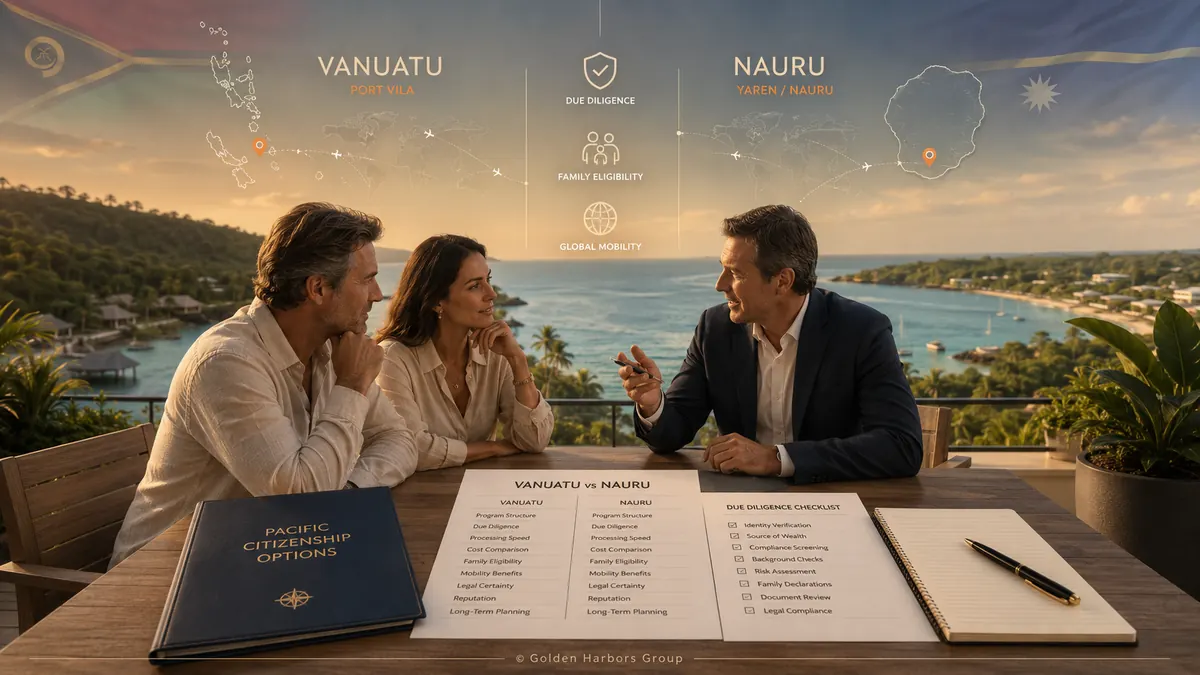
Nauru and Vanuatu run the two most affordable fast-track citizenship-by-investment programs in the Pacific. As of July 2026, Nauru starts at USD 90,000 under a discount window and Vanuatu at USD 130,000. Neither passport reaches the Schengen Area. For most buyers Nauru wins on cost and family scope, Vanuatu on raw speed.
Key Takeaways
- Nauru citizenship starts at a USD 90,000 contribution under the Iruwa Initiative discount, extended through 31 December 2026, versus Vanuatu's USD 130,000 minimum donation.
- Vanuatu is faster, with government processing often inside 1 to 2 months, while Nauru typically takes 3 to 4 months.
- Neither passport holds visa-free access to the Schengen Area, the United Kingdom, or the United States as of July 2026.
- Nauru includes siblings, parents, and grandparents with no age caps and charges only USD 2,000 per additional adult dependent, making it cheaper for large families.
- Vanuatu offers a partial-refund route (CIIP) that returns USD 50,000 after about four years; Nauru is donation-only.
Quick Facts: Nauru vs Vanuatu CBI 2026
| Nauru minimum contribution | USD 90,000 (discount, to 31 Dec 2026) |
| Vanuatu minimum donation | USD 130,000 (DSP, single applicant) |
| Nauru processing time | 3 to 4 months |
| Vanuatu processing time | 1 to 2 months |
| Visa-free destinations | Both roughly 86 to 88 (no Schengen, UK, or US) |
| Residency or visit required | Nauru: none. Vanuatu: biometrics visit since July 2025 |
| Refund option | Vanuatu CIIP refunds USD 50,000; Nauru none |
| Legal basis | Nauru Act No. 15 of 2024; Vanuatu DSP (since 2017) |
Nauru or Vanuatu: Which Is Better in 2026?
For most applicants in 2026, Nauru is the better value and Vanuatu is the better speed play. Nauru's discounted USD 90,000 entry and USD 2,000 per-dependent pricing make it cheaper for singles and large families, while Vanuatu's 1-to-2-month timeline is the fastest credible route in the market. Neither passport delivers European or North American access, so the decision rarely turns on mobility.
The honest framing is that these two programs compete for the same buyer: someone who wants a lawful second citizenship as insurance, not as a Schengen key. Both lost their European access, both run remote-friendly donation models, and both sit in the same visa-free band. What separates them is price structure, processing speed, family rules, and whether you want any money back.
How Much Does Each Program Cost in 2026?
Nauru is cheaper at the entry point: USD 90,000 versus USD 130,000 for a single applicant as of July 2026. The gap narrows once fees and family members are added, but Nauru keeps its lead for larger families because it charges only USD 2,000 per additional adult dependent.
Which Passport Is Faster to Get?
Vanuatu is faster. Government processing under the Development Support Program often completes in 45 to 60 days for a clean file, which is the quickest credible CBI timeline available in 2026. Nauru runs a thorough 3-to-4-month process from submission to approval.
Speed matters most for buyers with a time-sensitive reason to hold a second passport, such as an imminent relocation or a narrow banking window. If the calendar is the priority, Vanuatu is the stronger pick. One caveat since July 2025: Vanuatu now requires biometric capture, so applicants must visit Vanuatu or an approved overseas representation office at some stage, whereas Nauru remains fully remote.
How Strong Are the Two Passports?
Both passports are weak on premium mobility and close to each other overall. As of July 2026, Vanuatu sits near rank 50 with roughly 88 visa-free or visa-on-arrival destinations, and Nauru near rank 52 with roughly 86, according to the Henley Passport Index.
The decisive shared fact is what neither passport can do. Vanuatu lost visa-free Schengen access permanently on 12 December 2024 and now needs a United Kingdom ETA. Nauru, as a newer program, never held Schengen access. Both require visas for the Schengen Area, the United Kingdom, and the United States. Useful open destinations for both include Singapore, Hong Kong, and the United Arab Emirates.
Which Program Is Better for Families?
Nauru is the stronger family program in 2026. It allows spouses, children, parents, grandparents, and siblings in one application, and a February 2026 amendment removed age caps on children and parents and dropped the financial-dependency test. Additional adult dependents cost only USD 2,000 each, with a USD 15,000 supplement per sibling.
Vanuatu covers spouses, children, parents, and grandparents, but charges around USD 10,000 per additional dependent and does not treat siblings as a standard category. For a multigenerational application, Nauru is usually both broader and cheaper. For a single applicant or a couple in a hurry, Vanuatu's speed can outweigh the higher per-head cost.
Can You Get Any of the Money Back?
Only Vanuatu offers a refund, and only through its alternative route. The Capital Investment Immigration Plan (CIIP) sets a contribution around USD 165,000, of which about USD 50,000 is returned after roughly four years through a commodity fund structure. Nauru is donation-only, so its contribution is fully non-refundable.
The CIIP refund appeals to buyers who can lock up capital for four to five years and want a lower effective long-term cost. Weigh it against opportunity cost: the same USD 50,000 invested elsewhere may outperform the refund. For applicants who prize simplicity, Nauru's single non-refundable donation is easier to model.
How Do the Two Programs Compare on Reputation?
This is a genuine trade-off rather than a clean win. Vanuatu has operated since 2017 and has a long track record, but that record is also why the European Union permanently revoked its visa waiver in December 2024, citing weak screening on more than 10,000 passports issued between 2015 and 2021.
Nauru launched in November 2024 under the Nauru Economic and Climate Resilience Citizenship Act 2024 and frames its contribution around climate resilience and the Higher Ground Initiative. It is an International Migration Council member and references alignment with IMF and OECD guidance. Its newness cuts both ways: fewer legacy problems, but a shorter history for banks and governments to assess.
Common Mistakes to Avoid
The most frequent error is buying either passport for Schengen access. Both programs lost or never held it, and any agent implying otherwise is misrepresenting the product. A second mistake is budgeting only the headline contribution: due diligence, application, bank, and passport fees add several thousand dollars per person, and family members change the math quickly.
A third mistake is ignoring the discount clock. Nauru's USD 90,000 rate depends on the Iruwa Initiative window, currently set to close on 31 December 2026. A fourth is assuming both routes are fully remote; Vanuatu has required biometric capture since July 2025, so plan for a visit to Vanuatu or an approved office.
Frequently Asked Questions
Is Nauru or Vanuatu Cheaper in 2026?
Nauru is cheaper at entry. A single applicant contributes USD 90,000 under the Iruwa Initiative discount, valid to 31 December 2026, compared with USD 130,000 for Vanuatu's Development Support Program. Nauru also charges only USD 2,000 per additional adult dependent, so it stays cheaper for larger families. Add application, due diligence, and passport fees to both before comparing final totals.
Which Passport Has More Visa-Free Countries?
They are close. As of July 2026, Vanuatu reaches roughly 88 destinations visa-free or visa-on-arrival and Nauru roughly 86, per the Henley Passport Index. Vanuatu ranks marginally higher near position 50 versus Nauru near 52. Neither passport accesses the Schengen Area, the United Kingdom, or the United States without a visa, so the difference is small in practice.
Do Either of These Passports Give Schengen Access?
No. Vanuatu lost visa-free Schengen access permanently on 12 December 2024 after the European Union cited weak screening in its investor citizenship scheme. Nauru, launched in late 2024, never held Schengen access. Both nationalities require a Schengen visa for short stays. If European access is your goal, a Caribbean or European program is a better fit than either Pacific option.
Which Program Is Faster?
Vanuatu is faster. Government processing under the Development Support Program often completes within 45 to 60 days for a complete file, the quickest credible timeline in the citizenship-by-investment market. Nauru typically takes 3 to 4 months from submission to approval. If speed is the priority, Vanuatu leads, though it now requires a biometric visit that Nauru does not.
Can I Include My Parents and Siblings?
Nauru allows spouses, children, parents, grandparents, and siblings in one application, with no age caps after the February 2026 amendment. Siblings cost a USD 15,000 supplement and other adult dependents USD 2,000 each. Vanuatu covers spouses, children, parents, and grandparents but does not treat siblings as a standard category, making Nauru the broader choice for extended families.
Is Any of the Contribution Refundable?
Only through Vanuatu's alternative route. The Capital Investment Immigration Plan contributes around USD 165,000 and returns about USD 50,000 after roughly four years via a commodity fund. Nauru is donation-only and fully non-refundable. The refund suits buyers who can lock up capital for several years; those who prefer simplicity often favor a single non-refundable donation.
Do I Have to Visit Nauru or Vanuatu?
Nauru requires no visit at any stage and remains fully remote. Vanuatu introduced a biometric requirement in July 2025, so applicants must attend biometric capture in Vanuatu or at an approved overseas representation office. Neither program imposes a residency or minimum-stay requirement after citizenship is granted, and both permit dual citizenship.
Which Should I Choose Overall?
Choose Nauru for the lowest cost, the broadest family inclusion, and a fully remote process. Choose Vanuatu for the fastest timeline and the option of a partial refund through CIIP. Because both passports share similar mobility and neither reaches Europe, the decision usually comes down to budget, family size, and how quickly you need the passport in hand.
How Golden Harbors Helps
Golden Harbors advisors compare Pacific citizenship options against your actual goal, whether that is cost efficiency, speed, family coverage, or banking access, rather than defaulting to a single program. We map the full all-in cost for your family size, confirm current contribution figures against the official Nauru and Vanuatu schedules, and coordinate licensed agents on both sides.
Victoria Cold, Global Mobility Advisor at Golden Harbors, notes: "The mistake we see most often with Pacific programs is clients anchoring on the headline contribution and forgetting that family composition, not the entry price, usually decides which passport is cheaper in the end."
Stop weighing Nauru against Vanuatu in the abstract. Book a general consultation call with Golden Harbors, global mobility experts who walk you through the right Nauru or Vanuatu citizenship structure, timeline, and trade-offs for your specific family and budget.
Book a CallAbout the Author
Victoria Cold, Global Mobility Advisor at Golden Harbors, is an international lawyer and author of academic papers on corporate and immigration law. She holds multiple law degrees and speaks four languages, with deep coverage across Europe, the Middle East, and Asia. At Golden Harbors, she advises entrepreneurs, family offices, and international clients on cross-border structuring, residency, and citizenship-by-investment programs.
Last reviewed: July 2026.
Disclaimer: This article is for informational purposes only and does not constitute legal, tax, or immigration advice. Program terms, tax rates, and regulatory requirements change frequently. Verify current requirements before acting.
There are Always Options to EXPAND YOUR BOUNDARIES! Let's Discuss Yours
Every client is unique
Every case requires an individual approach and solution. Our years of experience in the industry allow us to provide both.
We will answer all your questions and provide detailed information about the available second passport and residency programs to help you make the right choice.
Victoria
Lead Attorney at Golden Harbors

Victoria
Lead Attorney at Golden Harbors
Read also

