Singapore Business Visa

Offshore services
Bundled Services
Top Citizenship & Residency
Articles & Research
About Us
Contact Us


.svg)


Trusted by Global Clients & Partners


June 20, 2026
6
min read

Cambodia Citizenship by Investment vs Naturalization 2026: Complete Guide

.svg)


2.2K

2.2K
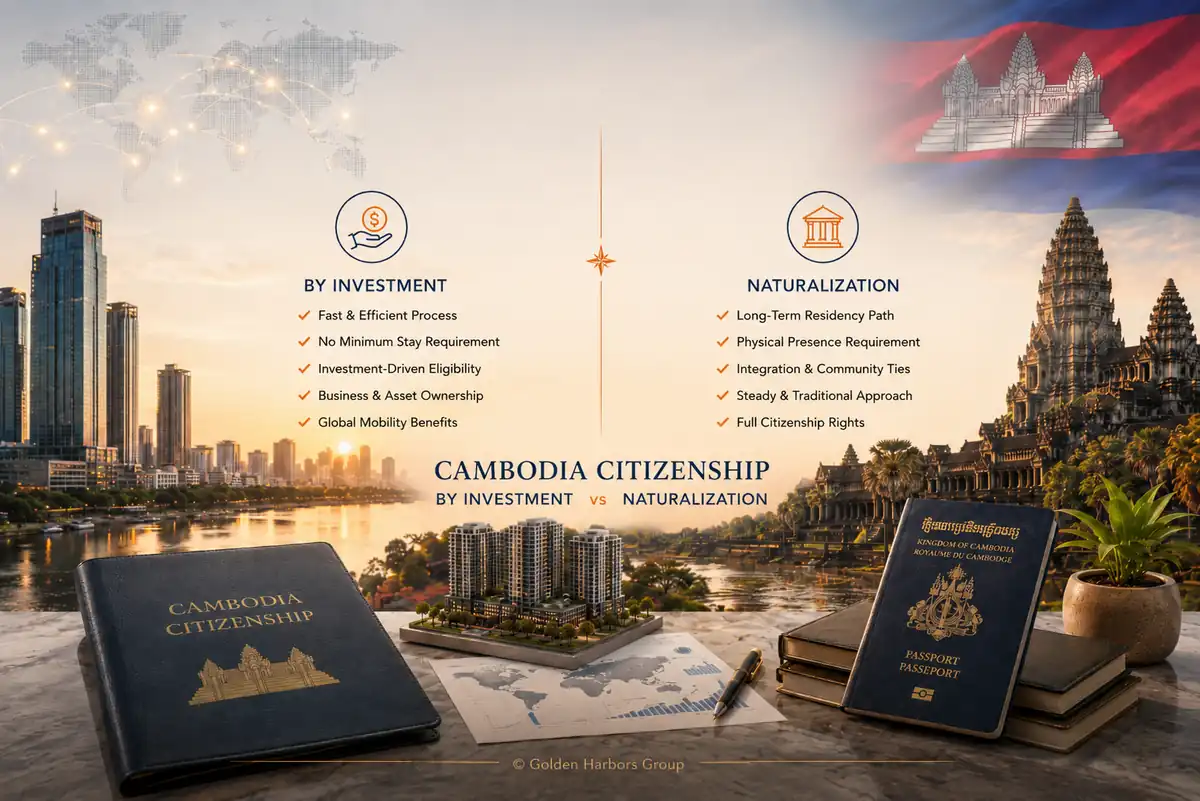
Cambodia offers two distinct paths to citizenship in 2026: the citizenship by investment (CBI) route, which grants a Cambodian passport in 4 to 5 months from a USD 245,000 donation with no residency requirement, and the standard naturalization route, which requires 7 years of legal residency in Cambodia plus Khmer language proficiency. Both pathways operate under the 1996 Law on Cambodian Nationality but serve different applicant profiles.
Key Takeaways
- Cambodia CBI: USD 245,000 donation to the Royal Government, 4 to 5 months processing, fully remote, no residency required, no Khmer language test.
- Cambodia naturalization: 7 years of continuous legal residency, Khmer language test, integration requirements, no contribution required.
- Both routes operate under the same legal framework (1996 Law on Cambodian Nationality) and produce the same Cambodian passport with identical rights.
- Cambodia permits dual citizenship under both routes. Applicants are not required to renounce existing nationality.
- The CBI route is built for HNW investors prioritizing speed and discretion. Naturalization suits long-term residents, spouses of Cambodian citizens, and those without USD 245,000 to commit upfront.
Quick Facts: Cambodia CBI vs Naturalization (2026)
What Are the Two Routes to Cambodian Citizenship in 2026?
Cambodia operates two formal pathways to citizenship under the 1996 Law on Cambodian Nationality. The first is citizenship by investment (CBI), a discretionary naturalization route activated by a one-time donation to the Royal Government. The second is standard naturalization, which requires a foreign national to legally reside in Cambodia for an extended period before applying for citizenship.
Both routes culminate in the same outcome: a Royal Decree from His Majesty the King granting Cambodian nationality, followed by issuance of a Cambodian passport with full citizen rights. The two routes diverge sharply at the entry stage, however, on three dimensions that shape every applicant's decision: capital required, time to passport, and physical presence in Cambodia.
Cambodia is one of only a handful of Asian jurisdictions offering a structured CBI program, and the only ASEAN member state with a formal investment citizenship route. The naturalization route is conventional and mirrors residency-based pathways in many other countries, though with Cambodia-specific language and integration requirements at the application stage.
How Does Cambodia Citizenship by Investment Work?
The Cambodia CBI route is structured as expedited naturalization under the discretionary authority of the Royal Government. The eligibility threshold is a one-time donation of USD 245,000 to the Royal Government of Cambodia, paid to a government-approved fund. The donation is non-refundable and does not generate any investment return; it functions as a fee paid in exchange for naturalization rights.
Process Overview
The CBI process follows a structured five-stage path. Stage one is service-agreement execution and intake. Stage two covers document preparation, apostille, and source-of-funds compilation (typically 30 days). Stage three is submission to the Royal Government, due-diligence review, and Royal Decree consideration (typically 60 days). Stage four is the oath of allegiance, administered through a licensed Cambodian agent on the applicant's behalf (typically 14 days). Stage five is naturalization-certificate issuance and passport delivery via DHL Express (typically 14 days).
The total elapsed time is 4 to 5 months. The official timeline is 3 to 4 months; real-world processing typically adds 1 to 2 months for home-country apostille delays, due-diligence depth (especially for HNW applicants with complex financial structures), and Royal Decree session timing.
Key Structural Features
No residency is required at any stage of the CBI process. No travel to Cambodia is required. The applicant does not need to learn Khmer or pass any language or integration test. The oath of allegiance is administered remotely through the licensed agent under formal legal authority, and sworn statements are executed through standard international notarization and apostille channels.
The CBI route is documented under Sub-Decree No. 225 of the Royal Government, which clarifies the operational framework for investment-based naturalization within the 1996 Nationality Law. The Ministry of Interior administers the application; the Council of Ministers reviews and recommends; the King issues final approval by Royal Decree.
How Does Cambodia Naturalization Work?
Standard naturalization is the conventional pathway to Cambodian citizenship through long-term residency. The legal framework sits in Article 11 of the 1996 Law on Cambodian Nationality, which sets the substantive eligibility criteria for foreign nationals seeking to become Cambodian citizens.
Residency Requirements
The core requirement is 7 years of continuous legal residency in Cambodia immediately preceding the naturalization application. The 7-year period must be uninterrupted; long absences from Cambodia (typically more than 6 months in any given year) can reset the clock or disqualify the application. Applicants must hold a valid Cambodian residency permit throughout the qualifying period, typically tied to employment, business activity, marriage to a Cambodian, or qualifying long-term visa categories.
The 7-year clock starts from the date of legal entry into Cambodia under a residency-eligible permit, not from arrival on a tourist visa. Applicants should plan their residency permit category carefully; not all visa types accumulate toward naturalization eligibility, and switching categories mid-stream can complicate the qualifying calculation.
Language and Integration Requirements
Article 11 requires applicants to demonstrate Khmer language proficiency, including the ability to read and write the language at a basic level. The language test is administered as part of the naturalization application and typically includes both oral and written components. There is no statutory exemption for older applicants; the requirement applies to all naturalization candidates.
Beyond language, applicants must demonstrate knowledge of Cambodian history, culture, and basic civics. The assessment is conducted during the naturalization interview, which is part of the standard application process. Applicants must also show good conduct (clean criminal record) and economic self-sufficiency.
Application and Approval
The naturalization application is filed with the Ministry of Interior after the 7-year residency threshold is met. The Ministry conducts background checks, verifies the language and integration assessments, and forwards qualifying applications to the Council of Ministers. Final approval comes by Royal Decree from the King. Total elapsed time from initial residency entry to passport issuance is therefore approximately 8 years (7 years residency plus 6 to 12 months for application processing).
Special Provisions for Spouses and Investors
Foreign nationals married to Cambodian citizens may qualify under an accelerated naturalization timeline, with the qualifying residency period reduced from 7 years. Foreign investors making significant contributions to the Cambodian economy may also qualify under modified rules, though in practice most investors with USD 245,000+ in available capital prefer the CBI route for its speed and predictability over the discretionary investor-naturalization carve-out.
Which Route Is Faster to a Cambodian Passport?
The CBI route is dramatically faster. From signed service agreement to delivered Cambodian passport, the typical CBI timeline is 4 to 5 months. The standard naturalization route, by contrast, requires 7 years of continuous residency before an application can even be filed, with an additional 6 to 12 months of Ministry review and Royal Decree issuance after that. The total naturalization timeline is roughly 8 years versus 4 to 5 months for CBI.
The speed differential is the single most consequential factor for HNW investors evaluating the two routes. CBI delivers the passport in roughly 6% of the naturalization timeline (5 months out of 96 months). For applicants whose primary goal is rapid acquisition of a second citizenship, CBI is structurally the only competitive option.
The trade-off is capital. The 4 to 5 month CBI timeline costs USD 245,000 in non-refundable donation. The 8-year naturalization timeline costs only standard government fees but requires the applicant to live in Cambodia for 7 years (taking on the opportunity cost, lifestyle commitment, and visa-maintenance burden that comes with it).
What Does Each Route Cost?
The cost structures of the two routes are fundamentally different. CBI is high upfront cost, low ongoing commitment. Naturalization is low upfront cost, high time and lifestyle commitment.
CBI Cost Components
The minimum donation is USD 245,000 to the Royal Government for the principal applicant. Adding dependents (spouse, dependent children, dependent parents) increases the donation per the Royal Government's family tariff. Government processing fees, due-diligence costs, and licensed-agent advisory fees apply separately and are confirmed at the contract stage. Total all-in cost for a single applicant typically ranges from USD 280,000 to USD 320,000 depending on documentation complexity.
Naturalization Cost Components
Naturalization carries no government contribution comparable to the CBI donation. Standard costs over the 7+ year journey include residency permit fees (recurring), document apostille and translation, naturalization application fees, and routine legal advisory. Cumulative direct fees typically total a few thousand US dollars across the full timeline.
The hidden cost of naturalization is opportunity cost. Spending 7 years residing in Cambodia means foregone earnings or lifestyle alternatives in higher-income jurisdictions, mandatory visa renewals and permit maintenance, and physical and family disruption. For HNW applicants whose time has high economic value, the implicit cost of the naturalization route can exceed USD 245,000 over 7 years even without any direct government contribution.
Which Route Requires Residency in Cambodia?
Only naturalization requires residency. CBI requires none.
Naturalization candidates must hold a valid Cambodian residency permit and physically reside in Cambodia for at least 7 continuous years before applying. The residency must be uninterrupted; substantial absences (typically more than 6 months in any year) can reset the qualifying clock or disqualify the application entirely. Applicants must maintain valid visa or permit status throughout, and the qualifying permit categories are limited to those that accumulate toward naturalization (employment, business, family reunification, qualifying retirement, marriage to a Cambodian citizen).
CBI applicants are not required to set foot in Cambodia at any stage of the application or after passport issuance. The fully remote structure of the CBI program means that the entire path (intake, documentation, due diligence, oath of allegiance, passport delivery) is executed through licensed Cambodian counsel acting on the applicant's behalf, with the final passport delivered via international courier.
The residency distinction has tax-residency implications. CBI citizens who never spend 183+ days per year in Cambodia are not Cambodian tax residents and do not face Cambodian tax on foreign-source income. Naturalization candidates, by definition, become Cambodian tax residents during their 7-year qualifying period (since 7 years of substantial physical presence triggers tax residency under Cambodia's day-count rule).
What Are the Language and Integration Requirements?
The two routes diverge sharply on language and integration. The CBI route imposes none. The naturalization route imposes both.
CBI Requirements (Minimal)
The Cambodia CBI route exempts applicants from Khmer language testing, knowledge-of-history assessments, integration interviews, and cultural orientation programs. The only knowledge required is sufficient capacity to execute the oath of allegiance through the licensed agent, which is administered in either English or the applicant's preferred language with sworn legal translation. No prior connection to Cambodia or Khmer culture is required.
Naturalization Requirements (Substantial)
Article 11 of the 1996 Nationality Law requires naturalization candidates to demonstrate working proficiency in Khmer, including basic reading and writing capability. The language assessment is administered as part of the naturalization application and typically includes both oral conversation and written exercises. There is no formal exemption for elderly applicants, applicants from non-Khmer-script backgrounds, or applicants with documented language disabilities.
Beyond language, the naturalization process includes a knowledge-of-Cambodia component, typically administered during the interview phase. Applicants are expected to demonstrate familiarity with Cambodian history, basic civic structure (the constitutional monarchy framework, the role of the National Assembly), and elements of Khmer culture. The integration assessment is qualitative and at the discretion of the Ministry of Interior reviewer, though the bar is generally accessible for applicants who have lived 7 years in Cambodia in good faith.
For most HNW applicants without prior connection to Cambodia, the language requirement alone makes naturalization impractical. Achieving the required Khmer proficiency typically takes 2 to 4 years of dedicated study; combined with the 7-year residency requirement, this puts CBI strictly ahead on every speed and accessibility metric except upfront cost.
Which Route Allows Family Members?
Both routes accommodate family members, but the mechanics differ materially.
CBI Family Inclusion
The Cambodia CBI program is family-inclusive in one consolidated application. The principal applicant may include:
- Legal spouse of the principal applicant, regardless of nationality.
- Financially dependent children, biological and legally adopted, typically up to age 30 if dependency is documented.
- Financially dependent parents of the principal applicant or spouse, not gainfully employed.
Each dependent triggers an additional contribution per the Royal Government family tariff. All family members are processed in parallel, due diligence is conducted across the full family unit, and Cambodian passports are issued to all included members within the same 4 to 5 month timeline as the principal applicant. Future children born after naturalization automatically acquire Cambodian citizenship by descent.
Naturalization Family Inclusion
Naturalization is structured as an individual application rather than a family one. Each adult family member must independently meet the 7-year residency, language, and integration requirements. There is no consolidated family application equivalent to the CBI route.
The exception is foreign spouses of Cambodian citizens (whether by birth or by prior naturalization), who qualify under an accelerated timeline shorter than 7 years. Children of a naturalized Cambodian acquire citizenship by descent automatically (jus sanguinis), so a successfully naturalized parent passes citizenship to subsequent children without requiring them to undergo their own naturalization.
For families seeking a single concentrated citizenship event, CBI is the clear structural fit. For families willing to migrate to Cambodia long-term, naturalization becomes feasible but requires each adult to satisfy the residency, language, and integration thresholds independently.
CBI vs Naturalization: Side-by-Side Comparison
The table below maps the two routes against every consequential decision criterion. Both produce the same Cambodian passport with identical rights at the end; the differences sit entirely at the eligibility and process stage.
← Swipe →
| Criterion | Citizenship by Investment | Naturalization |
|---|---|---|
| Minimum financial contribution | USD 245,000 to Royal Government | None (standard government fees only) |
| Time to passport | 4 to 5 months | 7+ years from initial residency |
| Residency requirement | None | 7 years continuous legal residence |
| Physical presence required | None (fully remote) | Substantial physical presence each year |
| Khmer language test | Not required | Required (basic reading and writing) |
| Knowledge of Cambodian history and culture | Not assessed | Assessed during naturalization interview |
| Source of funds documentation | Comprehensive, including apostilled records | Standard residency-permit documentation |
| Final approval authority | Royal Decree by the King | Royal Decree by the King after Ministry review |
| Family members included | Spouse, dependent children, dependent parents | Spouse and minor children (separate applications) |
| Dual citizenship | Permitted | Permitted |
| Renunciation of prior citizenship | Not required | Not required |
| Khmer name option | Available on passport | Available on passport |
| Rights granted at passport issuance | Full citizen rights, identical to naturalization | Full citizen rights, identical to CBI |
| Sources: 1996 Law on Cambodian Nationality (Articles 4 and 11); Sub-Decree No. 225 on Naturalization Procedures; Royal Government of Cambodia CBI program documentation, 2026. Both routes produce the same Cambodian passport with identical rights; the differences sit at the eligibility and process stage, not in the citizenship itself. | ||
Which Route Is Right for You?
The right route depends on three variables: capital availability, time horizon, and willingness to relocate. The framework below maps common applicant profiles to the route that fits best.
← Swipe →
| Applicant Profile | Recommended Route | Why |
|---|---|---|
| HNW investor with USD 245,000 capital and no time to relocate | Citizenship by Investment | 4 to 5 months to passport, no travel, no language test, no residency |
| Long-term Cambodia resident already 5+ years in country | Naturalization | Existing residency credits toward the 7-year requirement; preserves capital |
| Foreign spouse of a Cambodian citizen | Naturalization (accelerated) | Reduced residency period applies to qualifying spouses |
| Entrepreneur planning a Cambodian business and ASEAN base | Either, depending on capital and timeline | CBI gives immediate citizen rights (land ownership, business advantages); naturalization preserves capital but defers benefits by 7+ years |
| Retiree with passive income but no USD 245,000 capital lump sum | Naturalization (via retirement residency) | Allows passport acquisition over time without large upfront contribution |
| Family seeking second passport for mobility planning | Citizenship by Investment | Whole family (spouse, children, parents) included in one application; no travel required |
| Politically sensitive applicant with PEP status | Citizenship by Investment with enhanced due diligence | Structured remote process, single review cycle, faster certainty than 7-year naturalization |
| Source: Golden Harbors advisory framework for Cambodia citizenship route selection, 2026. Recommendations are general indicators; the right route depends on each applicant's full profile, source-of-funds picture, mobility needs, and tax-residency planning context. | ||
The decision framework above is general. Edge cases (politically exposed persons, applicants with sanctions exposure, applicants from countries that restrict dual citizenship, applicants with complex multi-jurisdictional tax structures) require individual review. Golden Harbors advisors run a pre-application eligibility review for both routes during initial consultation to identify the best fit for each client's complete profile.
Explore Cambodia Further
Common Mistakes to Avoid When Choosing a Cambodia Citizenship Route
Five recurring mistakes cost applicants time, money, or program access. Each one shows up regularly in advisory intake.
- Assuming naturalization residency credits toward CBI cost. The two routes are independent. Time spent on residency-based naturalization does not reduce the USD 245,000 CBI contribution. An applicant who has lived 4 years in Cambodia and decides to pivot to CBI still pays the full donation; the 4 years already spent are not refunded as a discount.
- Underestimating the Khmer language barrier. The naturalization language test is not optional and not symbolic. Reaching the required Khmer reading and writing proficiency typically takes 2 to 4 years of dedicated study for adults without prior exposure. Applicants who plan naturalization without a credible language-acquisition plan often fail at this stage even after completing the 7-year residency.
- Treating CBI as faster naturalization. CBI is not "naturalization on a shortcut." It is a separate discretionary pathway with its own due-diligence regime, its own documentation requirements (more comprehensive than residency-based naturalization), and its own approval mechanism (direct to Royal Decree). Approaching CBI with naturalization expectations leads to misaligned documentation packages and stalled applications.
- Confusing the CBI route with the Cambodia My Second Home (CM2H) visa program. CM2H is a 10-year renewable residency visa from approximately USD 100,000 in qualifying real estate or fixed deposit. It is not a citizenship route on its own. CM2H holders can pursue naturalization after 5 years of qualifying residency, but the visa does not directly produce a Cambodian passport the way CBI does. Some marketing materials conflate the two; they are structurally distinct.
- Working with unlicensed intermediaries. Cambodia CBI applications must be submitted through Royal Government-licensed local agents. Direct individual applications are not accepted. Working with non-licensed intermediaries, even those with sophisticated marketing presence, can result in stalled applications, lost retainers, or non-recoverable filing fees. The licensed-agent requirement applies equally on the naturalization side, though residency permits and individual visa filings can be done directly.
Frequently Asked Questions
What Is the Main Difference Between CBI and Naturalization in Cambodia?
CBI grants Cambodian citizenship in 4 to 5 months from a USD 245,000 donation with no residency, no travel, and no language test. Naturalization requires 7 years of continuous residency in Cambodia, Khmer language proficiency, and integration assessment, with no large upfront contribution. Both routes produce the same Cambodian passport with identical rights under the 1996 Law on Cambodian Nationality.
Can I Apply for CBI if I Am Already on the Naturalization Path?
Yes. The two routes are independent. An applicant who has lived in Cambodia for several years on a residency permit can pivot to CBI at any time by paying the USD 245,000 donation and completing the standard CBI application process. Time already spent on residency does not reduce the CBI contribution requirement. The pivot makes sense when speed becomes a higher priority than capital preservation.
Does Cambodia Require Renunciation of My Existing Citizenship Under Either Route?
No. Cambodia has permitted dual and multiple citizenships under both routes since the 1996 Nationality Law. Whether you naturalize through CBI or through residency, you retain your existing nationality. Cambodia is one of the few Asian jurisdictions with this dual-citizenship right; most regional neighbors (India, China, Singapore, Japan, Malaysia, Vietnam) require renunciation.
Is the Khmer Language Test the Hardest Part of Naturalization?
For most adult applicants without prior exposure to Khmer, yes. Khmer uses a unique script (derived from Brahmic Pallava), has tonal elements that differ from European languages, and is not widely taught outside Southeast Asia. Reaching the basic reading and writing proficiency required by Article 11 typically takes 2 to 4 years of dedicated study. The language test is the most common naturalization failure point for foreign applicants.
Are Cambodia CBI and Naturalization Passports Treated Differently?
No. Both routes produce the same Cambodian passport with identical rights. The passport itself does not record which route was used to acquire citizenship. Naturalized Cambodian citizens, whether through CBI or residency, hold the same legal status as Cambodian citizens by birth, including the right to vote, work, own land in Cambodia, and pass citizenship to children.
How Does Cambodia CBI Compare to Other Asian CBI Options?
Cambodia is one of only a small number of formal CBI programs in Asia. The most direct comparison is Jordan in the Middle East (similar pricing, longer processing) and Vanuatu in Oceania (lower cost at USD 130,000, faster at 4 to 6 weeks, but lost EU Schengen visa-free access in 2024). Within Southeast Asia specifically, Cambodia is the only ASEAN member state with an active CBI program, making it the strategic choice for investors targeting ASEAN bloc access.
Can Foreign Spouses Naturalize Faster Than 7 Years?
Yes. Foreign nationals legally married to Cambodian citizens may qualify under an accelerated naturalization timeline that reduces the qualifying residency period. The exact reduced period and supporting documentation requirements should be confirmed with Cambodian counsel based on each couple's individual situation. The Khmer language and integration requirements still apply at the application stage.
How Golden Harbors Helps
Golden Harbors advisors guide clients through both Cambodia citizenship routes from initial eligibility review through Royal Decree and passport collection. The team runs a pre-application assessment that maps applicant profile against the CBI and naturalization criteria simultaneously, surfacing the right route given each client's capital position, time horizon, family structure, and tax-residency planning context. For CBI applicants, the team coordinates Cambodian government-licensed local counsel, structures the donation, manages document apostille and source-of-funds packaging, and prepares the due-diligence file to Ministry of Interior screening standards. For naturalization candidates, advisors structure the residency permit category for proper accumulation toward the 7-year clock, coordinate Khmer language preparation, and manage the application file at the eligibility window. The Cambodia practice runs alongside the broader Asian portfolio (Singapore PR and company registration, UAE residency) and the global CBI bench (Vanuatu, Jordan, Egypt, the Caribbean five), allowing informed comparison if Cambodia is not the right fit for a particular profile.
Ready to move from research to action? Book a general consultation call with Golden Harbors, global mobility experts who walk you through the right Cambodia citizenship route, structure, timeline, and trade-offs for your specific situation.
Book a CallAbout the Author
Victoria Cold, European Attorney at Golden Harbors, is an international lawyer and author of academic papers on corporate and immigration law. She holds multiple law degrees and speaks four languages, with deep coverage across Europe, the Middle East, and Asia. At Golden Harbors, she advises entrepreneurs, family offices, and international clients on cross-border structuring, residency, and citizenship-by-investment programs.
Last reviewed: June 2026.
Disclaimer: This article is for informational purposes only and does not constitute legal, tax, or immigration advice. Program terms, tax rates, and regulatory requirements change frequently. Verify current requirements before acting.
There are Always Options to EXPAND YOUR BOUNDARIES! Let's Discuss Yours
Every client is unique
Every case requires an individual approach and solution. Our years of experience in the industry allow us to provide both.
We will answer all your questions and provide detailed information about the available second passport and residency programs to help you make the right choice.
Victoria
Lead Attorney at Golden Harbors

Victoria
Lead Attorney at Golden Harbors
Read also

