Singapore Business Visa

Offshore services
Bundled Services
Top Citizenship & Residency
Articles & Research
About Us
Contact Us


.svg)


Trusted by Global Clients & Partners


June 17, 2026
6
min read

Cambodia Passport 2026: Visa-Free Countries, Benefits, and How to Get One

.svg)


2.2K

2.2K
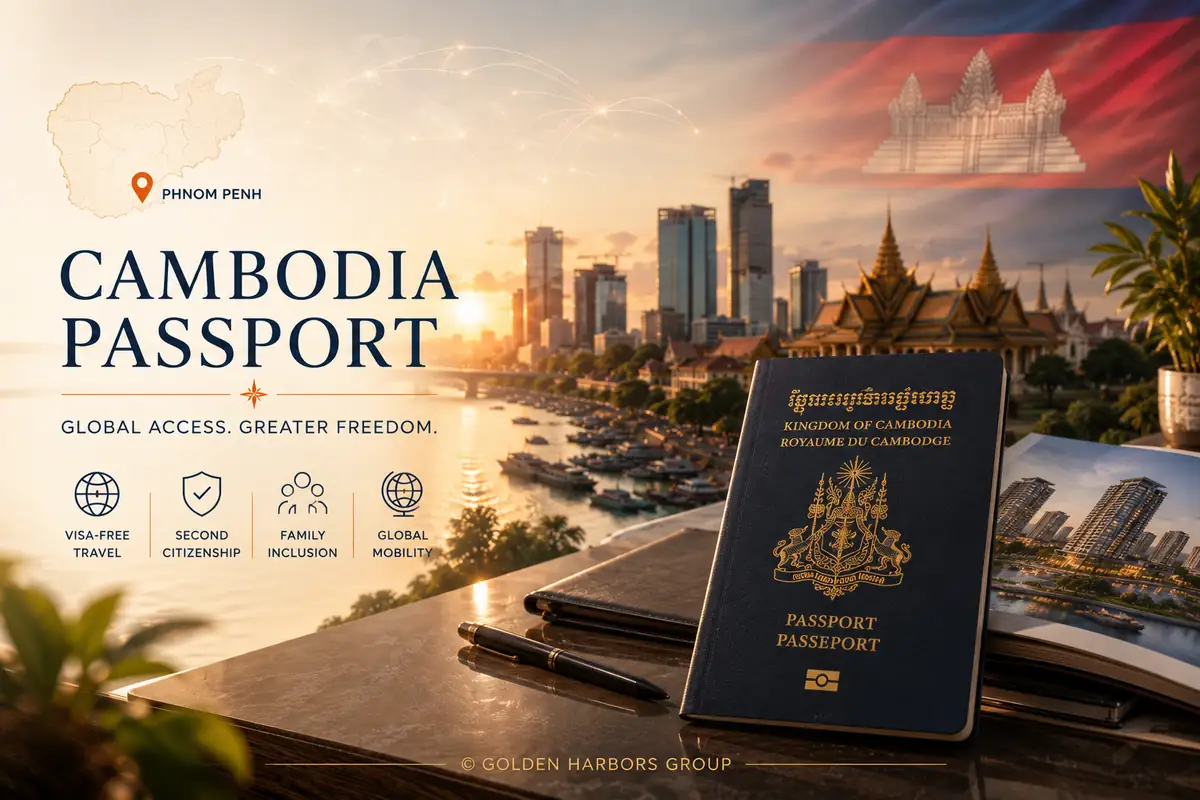
The Cambodia passport, ranked 85th on the 2026 Henley Passport Index, provides visa-free or visa-on-arrival access to approximately 56 countries including all ASEAN member states and selected destinations across Africa, Asia, Oceania, the Middle East, and the Americas. Citizenship is granted by Royal Decree, with a USD 245,000 donation to the Royal Government opening the fastest path to a Cambodian passport in 6 to 9 months, without any residency requirement.
Key Takeaways
- Cambodia passport ranks 85th on the 2026 Henley Passport Index with visa-free or visa-on-arrival access to approximately 56 countries
- Citizenship by Royal Decree investment route: USD 245,000 donation to the Royal Government, processed in 6 to 9 months, with no residency requirement
- Cambodia is the only ASEAN member with an investment citizenship pathway, granting full economic access across the bloc
- Cambodian nationals can purchase land directly, while foreigners are limited to condominium ownership
- Dual citizenship is permitted; the Cambodian passport is permanent and not subject to recurring immigration filings
Quick Facts: Cambodia Passport
What Is the Cambodia Passport?
The Cambodia passport is the official travel document issued by the Royal Government of Cambodia to Cambodian nationals through the Ministry of Interior. Cambodian citizenship is governed by the 1996 Law on Cambodian Nationality, with citizenship by investment provisions clarified through Sub-Decree No. 225 issued by the Royal Government.
Cambodia is the only member of the Association of Southeast Asian Nations (ASEAN) that operates an active investment citizenship pathway. While the program is formally structured as expedited naturalization granted by Royal Decree from His Majesty the King, it provides foreign investors with a direct path to full Cambodian nationality and an ASEAN passport in 6 to 9 months without residency obligations.
How Does the Cambodia Passport Rank Globally?
The Cambodian passport ranks 85th on the 2026 Henley Passport Index, providing visa-free or visa-on-arrival access to approximately 56 countries and territories. The ranking has remained broadly stable over the past decade as Cambodia maintains diplomatic relations across Southeast Asia, Africa, the Middle East, and parts of the Americas.
While the passport does not provide visa-free access to the Schengen Area, the United Kingdom, the United States, or Canada, it grants substantial mobility across emerging markets and serves as a strategic Plan B asset for investors seeking ASEAN bloc economic access alongside their primary citizenship.
Which Countries Are Visa-Free for Cambodian Passport Holders?
Cambodian passport holders benefit from visa-free, visa-on-arrival, or electronic travel authorization access across a regional cluster of destinations. The strongest mobility comes from ASEAN membership, which grants visa-free travel across all member states for stays of typically 14 to 30 days.
| Region | Notable Destinations | Access Type |
|---|---|---|
| ASEAN | Indonesia, Malaysia, Singapore, Thailand, Vietnam, Laos, Philippines, Myanmar, Brunei | Visa-free (typically 14 to 30 days) |
| South Asia | Nepal, Maldives, Sri Lanka | Visa on arrival or ETA |
| Africa | Rwanda, Tanzania, Mozambique, Madagascar, Comoros, Seychelles, Uganda, Cape Verde | Visa on arrival |
| Oceania | Palau, Samoa, Tuvalu, Micronesia | Visa on arrival |
| Middle East | Iran, Lebanon | Visa on arrival |
| Americas | Bolivia, Suriname, Saint Lucia, Saint Vincent and the Grenadines | Visa on arrival |
| East Asia | Macau (limited), Hong Kong (limited) | Visa-free for short stays |
| Source: Henley Passport Index 2026 (Henley & Partners). Destinations and stay duration limits vary by individual bilateral agreement; verify entry requirements before travel as visa policies are subject to change. | ||
What Are the Key Benefits of Holding a Cambodian Passport?
Beyond the mobility offered by visa-free destinations, the Cambodian passport delivers a set of structural benefits that distinguish it from other emerging-market investment passports.
ASEAN Bloc Economic Access
Cambodia is a full member of ASEAN, the 10-nation Southeast Asian economic bloc with a combined GDP of approximately USD 3.6 trillion. Cambodian nationals receive priority business and travel rights across all ASEAN member states, including streamlined visa-free movement, reduced trade barriers, and preferential investment treatment in many sectors.
Land Ownership Rights
Cambodian nationals can purchase and own land directly in their own name. Foreigners are restricted to condominium units above the ground floor and cannot hold land freehold. Citizenship therefore unlocks the full residential and commercial real estate market, including agricultural land and ground-floor commercial property.
Territorial Tax System
Cambodia operates under a territorial taxation framework: only income earned within Cambodia is subject to local tax. Foreign-source income, including dividends, capital gains, and business income from outside Cambodia, is generally not taxed even for tax residents.
No Residency Requirement
Unlike most naturalization routes that require 5 to 10 years of physical residency, the Cambodia citizenship by investment route waives all residency requirements. Investors receive permanent citizenship status without ever needing to live in Cambodia.
Dual Citizenship Permitted
Cambodia permits dual and multiple citizenships under its Nationality Law. New citizens are not required to renounce their original nationality. The Cambodian passport functions as a true second passport rather than a replacement.
Name Change Option
The naturalization process allows investors to adopt a Khmer name on their Cambodian passport, providing an optional layer of identity discretion that distinguishes Cambodia from most other investment citizenship programs.
How Do You Get a Cambodian Passport?
There are four primary pathways to a Cambodian passport. Most foreign investors pursue the donation route under the citizenship by investment framework, which is fastest and most predictable.
- Donation route: USD 245,000 non-refundable contribution to the Royal Government of Cambodia
- Investment route: USD 305,000+ minimum in a government-approved project (practical all-in often closer to USD 1,000,000)
- Standard naturalization: 7 years of continuous legal residency in Cambodia, plus language and integration requirements
- Cambodia My Second Home (CM2H): 10-year renewable visa from USD 100,000 in real estate, with citizenship eligible after 5 years
What Is the Cambodia Citizenship by Investment Route?
The Cambodia citizenship by investment route is a fast-track naturalization framework administered by the Ministry of Interior and finalized by Royal Decree from the King. It is the only investment-based citizenship pathway in Southeast Asia.
← Swipe →
| Route | Minimum Amount | Processing | Key Notes |
|---|---|---|---|
| Donation | USD 245,000 | 6 to 9 months | Non-refundable contribution to Royal Government; fastest and most predictable path |
| Investment | USD 305,000 (often $1M all-in) | 6 to 9 months | Government-approved project; more complex documentation and project-side compliance |
| Naturalization | None (residency-based) | 7+ years | Standard route requiring continuous legal residency, language and civic integration |
| CM2H Visa | USD 50,000 to USD 100,000 real estate | 30 days | 10-year renewable visa; citizenship eligible after 5 years of residency |
| Source: 1996 Law on Cambodian Nationality, Sub-Decree No. 225, and Cambodia My Second Home (CM2H) program (launched July 2022). The investment route's practical all-in cost typically exceeds the published minimum due to project structuring requirements. | |||
The donation route is straightforward: USD 245,000 (1 billion Cambodian Riel) flows to the Royal Government national budget through a designated bank transfer. The investment route requires a project approved by either the Cambodian Development Council or directly authorized by the Royal Government, with practical all-in costs typically pushing total commitment toward USD 1,000,000 due to project structuring, legal, and ongoing compliance requirements.
How Long Does the Cambodian Passport Process Take?
Official processing of the citizenship by investment route takes 6 to 9 months from application submission to Royal Decree issuance and passport collection. The initial Ministry of Interior review is targeted at 45 working days, after which the application moves through inter-ministerial vetting before final approval by Royal Decree from the King.
Applicants must visit Cambodia approximately three times during the process: once for biometric capture and document submission, once for the knowledge assessment, and once to take the oath of allegiance and collect the passport. Each visit is short (typically a few days) and does not require extended stays.
Which Family Members Can Be Included?
The Cambodia citizenship by investment route allows the principal applicant to include a defined set of immediate family members. After the main applicant receives Royal Decree approval, eligible dependents may apply for citizenship concurrently:
- Legal spouse
- Dependent children under 18 years of age
- Children aged 18 to 25 in some cases, subject to dependency demonstration
Each dependent triggers an additional fee of approximately USD 5,000 plus documentation costs. Dependent parents and siblings are not typically eligible under the standard CBI framework.
Does Cambodia Allow Dual Citizenship?
Yes. Cambodia permits dual and multiple citizenships under the 1996 Law on Cambodian Nationality. Applicants do not need to renounce their original nationality to receive Cambodian citizenship. The Cambodian passport is permanent (subject to the standard 10-year renewal of the physical document) and not tied to ongoing investment maintenance after the Royal Decree is issued.
Applicants should confirm dual citizenship implications under their home country's laws. Some nationalities, including certain Gulf states and several Asian countries, restrict or prohibit holding multiple passports.
What Are the Tax Implications of Cambodian Citizenship?
Cambodia operates under a territorial taxation system. Only income earned within Cambodia is subject to local tax. Foreign-source income, including dividends, capital gains, interest, and business income from outside Cambodia, is generally exempt even for those who establish Cambodian tax residency.
Key tax features for Cambodian residents:
- Personal income tax on Cambodia-source income: progressive rates from 0% up to 20%
- Corporate income tax: standard 20% on Cambodia-source profits
- Capital gains tax: 20% on the sale of Cambodian property (since 2024 implementation)
- Value Added Tax (VAT): 10% standard rate
- No wealth tax, inheritance tax, or gift tax
Cambodian citizenship by itself does not trigger Cambodian tax residency. Tax residency requires physical presence in Cambodia for at least 182 days in any 12-month period, or having a principal place of abode in Cambodia.
Common Mistakes to Avoid When Pursuing the Cambodian Passport
- Treating the program as a transactional fee payment; Cambodian citizenship is granted by Royal Decree, which involves discretionary review at multiple government levels
- Pursuing the investment route without project-level legal advice; practical all-in costs typically exceed the published USD 305,000 minimum significantly
- Failing to budget for the three required in-person visits and the knowledge assessment on Cambodian history and literature
- Confusing the CBI route with the Cambodia My Second Home (CM2H) program, which is a 10-year visa with separate citizenship eligibility after 5 years of residency
- Overlooking dual citizenship rules in the home country, particularly for nationals of states that restrict or revoke citizenship upon naturalization elsewhere
- Engaging unlicensed intermediaries; the program requires coordination with Ministry of Interior counsel and government-vetted local partners
Frequently Asked Questions
How Strong Is the Cambodia Passport in 2026?
The Cambodia passport ranks 85th on the 2026 Henley Passport Index, providing visa-free or visa-on-arrival access to approximately 56 countries and territories. While it does not include Schengen, the UK, the US, or Canada, it grants strong ASEAN bloc mobility and visa-on-arrival access across much of Africa, parts of Oceania, and selected destinations in the Middle East and Americas. The Cambodian passport functions effectively as a regional and emerging-market Plan B passport.
Can I Get a Cambodia Passport Without Visiting Cambodia?
No. The Cambodia citizenship by investment process requires approximately three short in-person visits to Cambodia during the 6 to 9 month timeline. Visits cover biometric capture and document submission, the knowledge assessment on Cambodian history and literature, and the oath of allegiance plus passport collection. Each visit is typically only a few days. The process does not require extended physical residence or relocation to Cambodia.
Is Cambodia Citizenship by Investment Legitimate?
Yes. The Cambodia citizenship by investment route is provided for under the 1996 Law on Cambodian Nationality, with implementation clarified through Sub-Decree No. 225 of the Royal Government. The program is administered by the Ministry of Interior and finalized by Royal Decree from His Majesty the King. Cambodia is the only ASEAN member state offering an investment citizenship route, and the program has been operational for over two decades.
Does the Cambodia Passport Give Visa-Free Access to Schengen?
No. The Cambodia passport does not provide visa-free or visa-on-arrival access to the Schengen Area, the United Kingdom, the United States, Canada, Australia, or Japan. Cambodian nationals must apply for short-stay visas through the relevant embassies or consulates before traveling to these destinations. The Cambodia passport is most useful as a complement to a primary passport rather than a sole travel document for global business mobility.
Can I Keep My Original Citizenship After Getting a Cambodian Passport?
Yes, in most cases. Cambodia permits dual and multiple citizenships under its Nationality Law, and the Cambodian government does not require new citizens to renounce their original nationality. However, dual citizenship outcomes depend on the laws of the applicant's home country. Some nationalities, including certain Gulf states, India, and others, restrict or revoke citizenship upon naturalization elsewhere. Applicants should confirm home-country rules before proceeding.
How Golden Harbors Helps
Golden Harbors advisors guide clients through the Cambodia citizenship by investment process from initial intake through Royal Decree and passport collection. The team coordinates Cambodian legal counsel and government-vetted partners, structures the donation or investment route to fit each client's profile, manages document apostille and translation, and prepares applicants for the knowledge assessment, oath of allegiance, and in-person visits. Golden Harbors also benchmarks the Cambodia route against alternative second-passport options such as Saint Kitts and Nevis citizenship by investment, the Panama Qualified Investor Visa, Uruguay residency under Law 20.446, the Chile residency by investment, and the Argentina Investment Visa.
Ready to move from research to action? Book a general consultation call with Golden Harbors, global mobility experts who walk you through the Cambodia passport structure, timeline, and trade-offs for your specific situation.
Book a CallAbout the Author
Victoria Cold, European Attorney at Golden Harbors, is an international lawyer and author of academic papers on corporate and immigration law. She holds multiple law degrees and speaks four languages, with deep coverage across Europe, the Middle East, and Asia. At Golden Harbors, she advises entrepreneurs, family offices, and international clients on cross-border structuring, residency, and citizenship-by-investment programs.
Last reviewed: June 2026.
Disclaimer: This article is for informational purposes only and does not constitute legal, tax, or immigration advice. Program terms, tax rates, and regulatory requirements change frequently. Verify current requirements before acting.
There are Always Options to EXPAND YOUR BOUNDARIES! Let's Discuss Yours
Every client is unique
Every case requires an individual approach and solution. Our years of experience in the industry allow us to provide both.
We will answer all your questions and provide detailed information about the available second passport and residency programs to help you make the right choice.
Victoria
Lead Attorney at Golden Harbors

Victoria
Lead Attorney at Golden Harbors
Read also

