Singapore Business Visa

Offshore services
Bundled Services
Top Citizenship & Residency
Articles & Research
About Us
Contact Us


.svg)


Trusted by Global Clients & Partners


July 10, 2026
6
min read

Chile Residency by Investment 2026: Investor Visa Cost & Process

.svg)


1.7K

1.7K
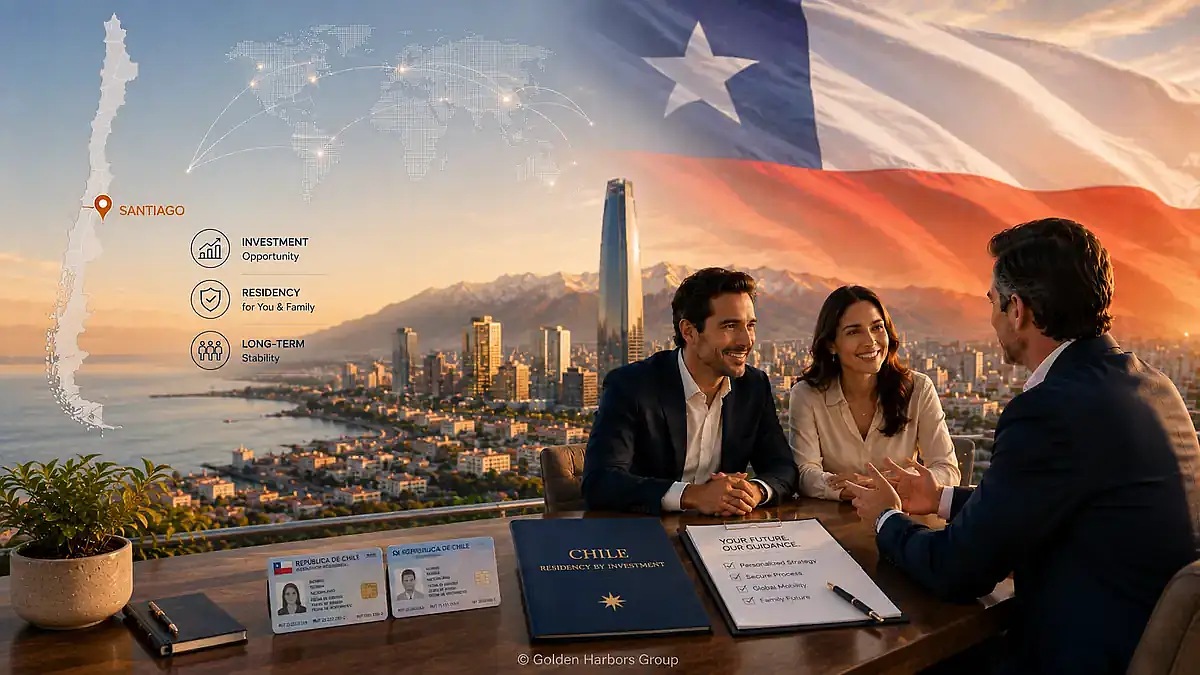
Chile residency by investment is granted through the Inversionista (Investor) Visa under Decree 177 of 2022. Foreign nationals qualify by investing at least USD 500,000 in a productive Chilean project, securing a sponsorship letter from InvestChile, and applying through the SERMIG online portal. The visa opens the path to permanent residency in 2 years and citizenship in 5.
KEY TAKEAWAYS
- Chile's Investor Visa requires a minimum USD 500,000 investment in a productive project or business. Real estate alone does not qualify.
- An alternative track is open to senior managers or executives at Chilean companies with at least 10% foreign-controlled voting rights.
- Processing typically takes 90 to 120 days from a complete application submission via the SERMIG online portal.
- The path to permanent residency is 2 years of temporary residency, with Chilean citizenship eligible after 5 years total legal residence.
- Chile recognizes dual citizenship and its passport gives visa-free access to 174 destinations (Henley Passport Index 2026), the strongest in Latin America.
QUICK FACTS
| Program name | Inversionista Visa (Investor Visa) |
| Legal basis | Decree 177 of 2022, Law 21.325 |
| Minimum investment | USD 500,000 in a productive project |
| Alternative track | Senior manager at 10%+ foreign-controlled Chilean company |
| Processing time | 90 to 120 days (typical) |
| Initial visa validity | 1 to 2 years, renewable |
| Permanent residency | After 2 years of temporary residency |
| Citizenship eligibility | After 5 years total legal residence |
| Dual citizenship | Permitted |
| Passport visa-free access | 174 destinations (Henley 2026) |
| Family inclusion | Spouse, dependent children, parents |
| Physical presence | 180+ days per year to qualify for PR |
Why Chile Is a Strategic Residency Choice in 2026
Chile sits in a category of its own in Latin America. It holds the strongest sovereign credit rating in the region (A from S&P, as of 2026), the lowest corruption index score, and a passport that opens 174 destinations visa-free, including the United States and Canada. For investors evaluating Latin American mobility plays, Chile is the bench against which Argentina, Uruguay, Paraguay, and Colombia get measured.
The 2026 macroeconomic case is grounded in two structural exports the world is short of: copper and lithium. The Banco Central de Chile's easing cycle has supported domestic consumption, while the USD 100 billion mining project pipeline and accelerating data-center investment from hyperscale tech firms have created sustained demand for foreign capital and skilled operators. For investors making a USD 500,000 commitment, the underlying economy is doing real work, not relying on a marketing brochure.
The residency framework itself was rebuilt in 2022. Law 21.325 and its implementing Decree 177 replaced a 1975-era system, codified the USD 500,000 investor threshold, formalized the role of InvestChile as the sponsoring agency, and moved all applications to the SERMIG online portal. The result is a more predictable, more transparent process than what existed under the old contract-bound visa regime.
What Has Changed Since 2022
Three updates matter for 2026 applicants. First, tourist-to-investor status changes are no longer possible from inside Chile. The application must be filed from abroad through SERMIG before arrival. Second, the InvestChile sponsorship letter is a hard gate. No sponsorship, no application. Third, Chile's new resident foreign-income tax exemption now runs for 3 years and can be extended to 6 years upon request through the Servicio de Impuestos Internos, which materially changes the tax calculus for high-net-worth families relocating.
Who Qualifies for the Chile Investor Visa in 2026?
Decree 177 of 2022 collapsed dozens of legacy investor categories into two clear tracks. Both lead to the same temporary residency permit, but the eligibility logic is distinct.
Track One: The Direct Investor
The applicant invests, or commits to invest, a minimum of USD 500,000 in a Chilean project that produces goods or services. The investment can take several forms.
- Founding a new Chilean company with operating activity, payroll, and a verifiable business plan
- Acquiring an existing Chilean business, either in whole or in part, where the capital injection meets the threshold
- Funding a joint venture with a Chilean partner where the foreign capital contribution is at least USD 500,000
- Expanding an existing Chilean operation through a documented capital increase
What does not qualify on its own is personal real estate. Buying a primary residence, a vacation home, or even a buy-to-let portfolio without an underlying productive business will not satisfy Decree 177. Real estate inside a larger productive project, with documented job creation and economic contribution, can be part of the qualifying structure.
Track Two: The Executive or Senior Manager
The second track is built for multinational structures. A foreign company that holds at least 10% of the voting rights in a Chilean subsidiary can sponsor executives, directors, managers, and specialized technical personnel for the same visa. The applicant does not personally invest USD 500,000. The qualifying capital sits at the corporate level, and the visa flows to the people running the Chilean operation.
This track is meaningful for tech founders moving regional headquarters to Santiago, for partners at international law or consulting firms opening a Chilean office, and for senior operators sent in to run a recently acquired Chilean subsidiary.
Family Inclusion
Both tracks extend to immediate family. Spouse, dependent children, and in some cases parents can be included in the principal application. Each dependent files supporting documentation (marriage certificate, birth certificates, apostilled) but does not need to make a separate investment.
How Much Does the Chile Investor Visa Cost in 2026?
The headline number is the USD 500,000 minimum qualifying investment, but the all-in cost is broader. The table below is built for a single principal applicant filing from abroad, using the productive-investment track.
| Cost Item | Amount (USD) |
|---|---|
| Qualifying productive investment | USD 500,000 minimum |
| Alternative track (executive) | 10%+ foreign-controlled Chilean entity |
| InvestChile sponsorship letter | No government fee |
| SERMIG visa application fee | USD 0 to 2,700 (nationality-based) |
| Document apostille and certified translation | USD 500 to 2,000 |
| Police clearance certificate (per applicant) | USD 50 to 200 |
| Civil registry (Registro Civil) and PDI registration | Free |
| RUT (Chilean tax ID) issuance | Free |
| Legal advisory and structuring | Quote on engagement |
| Estimated total fixed costs (excluding investment) | USD 1,000 to 5,000 |
| Sources: Decreto 177 de 2022, Biblioteca del Congreso Nacional de Chile; Servicio Nacional de Migraciones (SERMIG) fee schedule, 2026; InvestChile sponsorship documentation. Fixed-cost range excludes legal advisory and the qualifying investment. | |
A founder bootstrapping a Chilean SME on a smaller commitment (roughly USD 60,000 to 75,000) does not qualify for the Investor Visa, but may qualify for other Chilean residency subcategories such as the work-based temporary residence or the Rentista visa. Golden Harbors advisors regularly structure across these options when the productive-investment threshold is not the right fit.
How Does the Chile Investor Visa Process Work?
The end-to-end process has 5 sequential stages. Most files clear in 90 to 120 days from a complete submission, though complex investment structures or incomplete documentation can extend that window.
Step 1: Structure the Investment and Compile Documents
Before anything reaches InvestChile, the investment vehicle has to exist on paper. That means a Chilean corporation (typically an SpA or a Sociedad de Responsabilidad Limitada), opened accounts with the Servicio de Impuestos Internos, a documented capital plan, and a business plan that explains the productive activity and projected job creation. Personal supporting documents (passport, apostilled police clearance, marriage and birth certificates for dependents, proof of funds) are gathered in parallel.
Step 2: Obtain the InvestChile Sponsorship Letter
The applicant submits the project file to InvestChile through its online tools portal. The agency evaluates the productive nature of the investment, its alignment with Chilean development goals, and the financial backing. If the project clears review, InvestChile issues the Carta de Patrocinio (Sponsorship Letter). This document is the visa-application gate. Without it, the SERMIG portal will not process an investor file.
Step 3: File the Visa Application Through SERMIG
With the sponsorship letter in hand, the principal applicant logs into the SERMIG portal and files the Solicitud de Residencias Temporales para Extranjeros Fuera de Chile. The file must be opened from outside Chile. Tourist-to-investor status conversions inside the country are not permitted under the 2022 reform. Government fees are paid online and range from USD 0 to 2,700 depending on the applicant's nationality.
Step 4: Receive the Temporary Investor Visa
Approval typically arrives within 90 to 120 days. The temporary residency is issued for 1 to 2 years and is renewable. The visa is stamped or affixed at the Chilean consulate in the applicant's country of residence, after which the family can travel to Chile.
Step 5: Register With the PDI and Civil Registry
Within 30 days of arrival in Chile, every visa holder must register with the Policía de Investigaciones (PDI) and book an appointment with the Servicio de Registro Civil to obtain the Chilean ID card (Cédula de Identidad para Extranjeros) and the RUT (tax identification number). The RUT is what enables local banking, payroll, property registration, and tax compliance.
What Documents Does the Chile Investor Visa Require?
The supporting file has personal documents, project documents, and corporate documents.
Personal documents include a passport valid for at least 12 months from the application date, apostilled police clearance certificates from every country the applicant has lived in for the past 5 years, apostilled marriage and birth certificates for dependents, proof of funds (bank statements, audited financials, tax returns), and a CV or professional profile.
Project and corporate documents include the InvestChile Sponsorship Letter, the Certificado de Inicio de Actividades from the SII, the Carpeta Tributaria Electrónica, the municipal patente certification (where applicable), the company's incorporation deed, and the documented investment plan with capital deployment schedule, in line with InvestChile Exempt Resolution 144 of 2022.
Documents that are not in Spanish or English need certified translation by a sworn translator. Foreign-issued documents need apostille per Articles 345 and 345 bis of the Chilean Code of Civil Procedure. Private-sector documents are valid 30 days from issuance, public-sector documents 60 days, unless the document itself states a longer validity.
How Does Chile Taxation Affect Investor Residents?
Chile's tax architecture is one of the underrated reasons investors short-list the country. Three things matter.
First, new residents qualify for a foreign-source income tax exemption for the first 3 years of residency, extendable to 6 years upon application to the Servicio de Impuestos Internos. During that window, only Chile-source income is taxed. Investment portfolios held abroad, foreign rental income, foreign business distributions, and capital gains on foreign assets fall outside the Chilean tax base.
Second, the corporate tax regime is straightforward. Standard corporate income tax is 27%, and SMEs that qualify for the Régimen Pro Pyme face a 25% rate. Capital gains on Chilean real estate are taxed at a flat 10% above an 8,000 UF lifetime exemption (roughly USD 280,000 to 329,000 at 2026 UF values) for the primary residence. There is no wealth tax.
Third, Chile's network of double-taxation treaties covers more than 30 jurisdictions, including the US, UK, Spain, Canada, Australia, Japan, and most of the EU. For families with cross-border income, the treaty network reduces the risk of paying tax twice on the same dollar.
The 3-to-6 year foreign-income exemption is the headline. It does not eliminate compliance obligations elsewhere (US citizens still owe US worldwide taxation regardless of Chilean residency), but it materially reduces the Chilean side of the equation during the early residency years.
What Are the Pros and Cons of Chile Residency by Investment?
| Advantages | Trade-offs |
|---|---|
| Path to citizenship in 5 years and 174-destination visa-free passport | USD 500,000 minimum is higher than Argentina, Paraguay, or Uruguay alternatives |
| 3 to 6 year foreign-source income tax exemption for new residents | Real estate alone does not qualify; productive activity required |
| InvestChile sponsorship provides government endorsement of the project | 180+ days per year physical presence needed to qualify for permanent residency |
| Dual citizenship recognized; no requirement to renounce | Most documentation must be apostilled and translated to Spanish |
| Most stable sovereign credit rating and lowest corruption index in Latin America | Tourist-to-investor status changes from inside Chile are not permitted |
| Family inclusion (spouse, children, parents) with no additional investment | Standard corporate tax of 27% on Chilean profits is higher than Paraguay or Panama |
| Sources: Decreto 177 de 2022 (Biblioteca del Congreso Nacional de Chile); Henley Passport Index 2026; Servicio de Impuestos Internos (SII) foreign resident guidance. | |
How Does Chile Compare to Argentina and Uruguay?
Latin America's three most-discussed residency pathways are not interchangeable. Chile asks for a serious productive investment, Argentina has the lowest financial bar and the fastest citizenship route, and Uruguay sits between them with a strong tax position and a quieter lifestyle.
← Swipe →
| Criterion | Chile | Argentina | Uruguay |
|---|---|---|---|
| Investor visa threshold | USD 500,000 productive | ARS equivalent of USD ~15,000+ productive | No fixed threshold; ~USD 525,000 real estate fast-track |
| Path to PR | 2 years | 2 to 3 years | Direct (granted on approval) |
| Path to citizenship | 5 years | 2 years | 3 years (married) / 5 years (single) |
| Passport visa-free | 174 destinations (Henley 2026) | 171 destinations | 156 destinations |
| Foreign income | Exempt 3 to 6 years (renewable) | Worldwide taxation | 10-year holiday or flat 7 percent (2026 reform) |
| Physical presence | 180+ days/year | Loose enforcement in practice | Variable; tax residency triggers at 183 days |
| Real estate qualifies alone | No | No (for investor visa) | Yes (fast-track route) |
| Sources: Henley Passport Index 2026; Decreto 177/2022 (Chile); Dirección Nacional de Migraciones (Argentina); Dirección Nacional de Identificación Civil (Uruguay). Thresholds and timelines reflect 2026 program terms; verify before filing. | |||
The choice often comes down to what the principal applicant actually wants. Investors who want institutional credibility, a serious passport, and a tax-favorable runway choose Chile. Investors who want speed-to-citizenship at the lowest possible financial bar choose Argentina. Investors who want a long foreign-income exemption window and a quiet lifestyle choose Uruguay.
Common Mistakes to Avoid When Applying
The most expensive errors on Chile investor files have nothing to do with the USD 500,000 itself. They are procedural. Several patterns recur.
Filing from inside Chile on a tourist visa is the most common. Since 2022, the SERMIG portal blocks tourist-to-investor conversions. The application has to come from abroad, full stop.
Submitting a real-estate-only project without a productive layer is the second. Decree 177 specifically requires economic activity that produces goods or services. A pure property portfolio, even a multi-million-dollar one, will not clear InvestChile review.
Underbudgeting the InvestChile sponsorship process is the third. The sponsorship letter is not a rubber stamp. InvestChile evaluates the business plan, capital structure, sectoral fit with Chilean development priorities, and job creation potential. A weak file gets rejected, and rejection means restarting the project documentation from scratch.
Skipping apostille and certified translation is the fourth. Documents missing apostille or accompanied by uncertified translations are returned without review. The 30-day private-document and 60-day public-document validity windows compound the problem if the file sits in queue.
Frequently Asked Questions
What Is the Minimum Investment for Chile Residency by Investment in 2026?
The minimum is USD 500,000 invested in a productive Chilean project that creates goods or services, formalized under Decree 177 of 2022. The investment must be sponsored by InvestChile and cannot consist of personal real estate alone. Executives at Chilean companies with at least 10% foreign-controlled voting rights qualify under a separate track without making a personal USD 500,000 investment.
Can I Get Chile Residency by Buying Real Estate?
No, not on its own. Chile's Investor Visa requires the capital to flow into productive economic activity. Buying a primary residence, a vacation home, or a rental portfolio does not satisfy Decree 177. Real estate embedded inside a larger productive business (for example, a hotel operation, an industrial facility, or a development project with job creation) can be part of the qualifying USD 500,000 structure.
How Long Does the Chile Investor Visa Take to Process?
Typical processing runs 90 to 120 days from a complete SERMIG submission, assuming the InvestChile sponsorship letter is in hand and all supporting documents are apostilled and translated. Complex investment structures, large family files, or document gaps can extend the timeline. The PDI and Civil Registry registration after arrival adds another 2 to 4 weeks before the Chilean ID card is issued.
Can I Include My Family in the Application?
Yes. The principal applicant can include a spouse, dependent children, and in some cases parents. Each dependent must submit apostilled and translated supporting documents (marriage certificate, birth certificates, police clearance for adults over 18) but does not need to make a separate investment. Family members receive the same temporary residency status and are included in the path to permanent residency and citizenship.
When Can I Apply for Chilean Citizenship?
Chilean citizenship is available after 5 years of continuous legal residency, which includes both the temporary investor visa years and subsequent permanent residency time. Applicants must demonstrate basic Spanish, knowledge of Chilean civics, and good standing (no significant criminal record). Chile permits dual citizenship, so applicants do not have to renounce their original nationality to naturalize.
Does Chile Tax My Foreign Income After I Move There?
For the first 3 years of residency, Chile exempts new residents from tax on foreign-source income. The exemption can be extended for a further 3 years (6 years total) upon application to the Servicio de Impuestos Internos. After the exemption window closes, residents are taxed on worldwide income at progressive personal rates up to 40%. US citizens remain subject to US worldwide taxation regardless of Chilean residency status.
How Golden Harbors Helps With Chile Residency by Investment
Chile is a procedurally precise jurisdiction. Files that look fine on paper still get returned over apostille gaps, translation deficiencies, or InvestChile sponsorship language that does not match SERMIG's expected format. Golden Harbors advisors structure Chile Investor Visa files end-to-end: project design and business plan drafting that aligns with InvestChile's sectoral priorities, Chilean corporate formation (SpA or Ltda) with the right capital architecture, sponsorship letter strategy, SERMIG submission, and post-arrival PDI and Civil Registry coordination.
For families running multi-jurisdictional structures, the advisory work extends to coordinating Chile's 3-to-6 year foreign-income exemption with home-country tax obligations, treaty positioning, and second-passport planning across Latin America. Our team works with Banco de Chile, Banco Santander Chile, and Banco Estado on banking onboarding for new residents, and coordinates with the Chile residency program across investor, retirement, and rentista routes.
Sergey Voinich, Founder and Managing Partner at Golden Harbors, notes: "On Chile files, the investment itself is rarely the problem. The file lives or dies on the InvestChile sponsorship letter, and we have seen strong projects stall purely because the business plan was not framed the way the agency reads it."
You've read the program; now build the plan. Book a general consultation call with Golden Harbors, global mobility experts who walk you through the right Chile Investor Visa structure, InvestChile sponsorship strategy, and timeline for your specific situation.
Book a CallAbout the Author
Sergey Voinich, Founder and Managing Partner at Golden Harbors, is a foreign attorney specializing in international, patent, and copyright law, with over 20 years of experience across CIS finance and US technology sectors. He has held roles at PayPal, eBay, and Amazon and is certified by the Investment Migration Council. At Golden Harbors, he leads a team focused on global citizenship and residency solutions for entrepreneurs and family offices.
Last reviewed: July 2026.
Disclaimer: This article is for informational purposes only and does not constitute legal, tax, or immigration advice. Program terms, tax rates, and regulatory requirements change frequently. Verify current requirements before acting.
There are Always Options to EXPAND YOUR BOUNDARIES! Let's Discuss Yours
Every client is unique
Every case requires an individual approach and solution. Our years of experience in the industry allow us to provide both.
We will answer all your questions and provide detailed information about the available second passport and residency programs to help you make the right choice.
Victoria
Lead Attorney at Golden Harbors

Victoria
Lead Attorney at Golden Harbors
Read also

