Singapore Business Visa

Offshore services
Bundled Services
Top Citizenship & Residency
Articles & Research
About Us
Contact Us


.svg)


Trusted by Global Clients & Partners


July 3, 2026
6
min read

Dominica Entrepreneur Visa 2026: Investment, Requirements, Timeline

.svg)


1.4K

1.4K
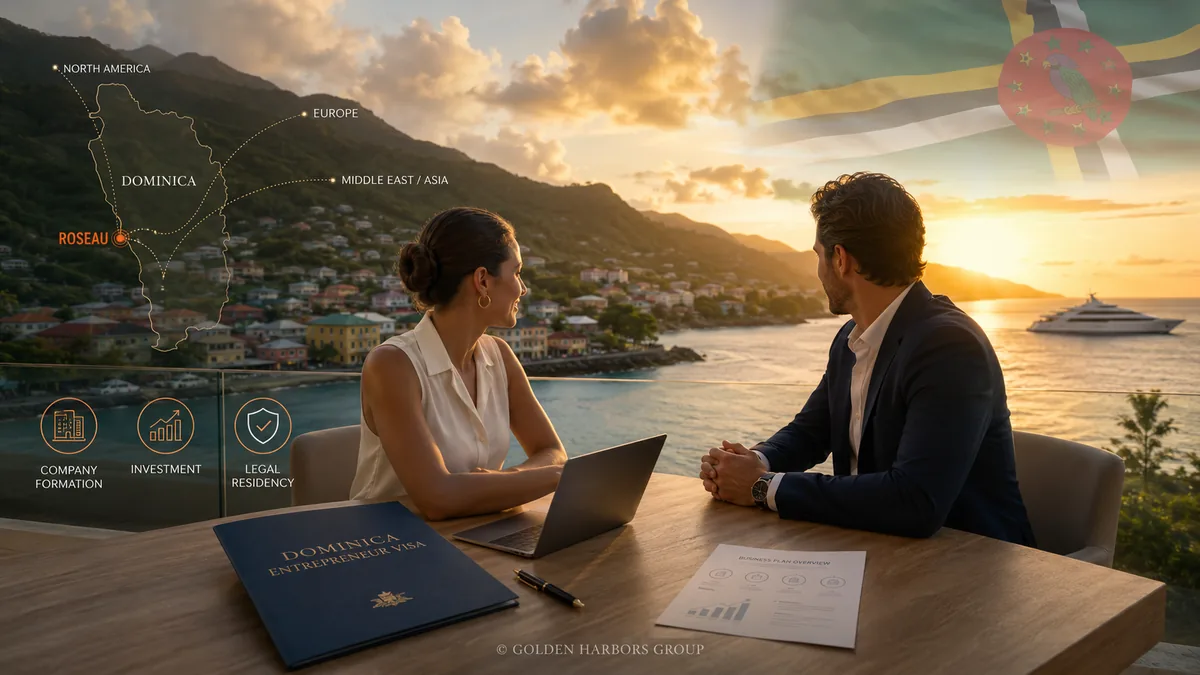
The Dominica Entrepreneur Visa is a 2-year renewable residency permit granted to foreign investors who commit at least USD 50,000 to a government-approved Dominican business, or USD 100,000 to a locally registered startup with three or more employees. After 2 years of residency with maintained investment, holders become eligible to apply for Dominican citizenship through naturalization, delivering a passport with 145 visa-free destinations under the Henley Passport Index 2026.
Key Takeaways
- Entrepreneur Visa vs Dominica CBI: the Entrepreneur Visa is a residency-first pathway (2-year residence with maintained investment, then citizenship application) starting from USD 50,000, versus direct CBI at USD 200,000 with citizenship in 6 to 9 months.
- Three qualifying investment routes: government-approved existing business from USD 50,000, locally registered startup with three or more full-time employees from USD 100,000, or equity participation in approved public or private ventures.
- Physical presence: minimum residency days required across the 2-year permit period. Spouse and dependent children may be included in the principal applicant's file.
- Processing to residency permit: approximately 45 days after formal approval. Citizenship application follows after the 2-year residency plus maintained investment, subject to Dominica's naturalization law.
- The Entrepreneur Visa was introduced in September 2020 and operates alongside the Dominica Citizenship by Investment Programme, offering a lower entry cost for entrepreneurs willing to actively invest in the local economy and reside in Dominica.
Quick Facts: Dominica Entrepreneur Visa 2026
What Is the Dominica Entrepreneur Visa in 2026?
The Dominica Entrepreneur Visa is a 2-year renewable residency permit introduced by the Commonwealth of Dominica in September 2020 to attract foreign entrepreneurs, investors, and remote business operators to the country. Unlike the Dominica Citizenship by Investment Programme, which grants direct citizenship in 6 to 9 months in exchange for a non-refundable donation or real estate purchase, the Entrepreneur Visa delivers residency first and citizenship second through Dominica's standard naturalization pathway.
The programme is administered jointly by the Dominica Citizenship by Investment Unit (CBIU) and the Immigration Department. Investment is directed into active Dominican businesses rather than a government development fund, which makes the Entrepreneur Visa a genuine business-migration route rather than a donation-for-passport transaction.
The best fit is entrepreneurs, family office principals, and international business owners who want a Caribbean base with 0% foreign income tax, are comfortable with a 2-year residency commitment, and prefer lower upfront cost with active business exposure over the direct CBI's higher one-time cost with no residency requirement. See the most affordable citizenship and residency programs guide for how the Entrepreneur Visa compares against Paraguay, Panama, and Latin American residency alternatives.
How Much Does the Dominica Entrepreneur Visa Cost?
The Entrepreneur Visa's headline cost varies by investment route. The minimum entry point is USD 50,000 for investment into an existing government-approved Dominican business. The startup route requires USD 100,000 and creation of at least three full-time local jobs. Both routes carry government processing fees, due diligence fees, and legal advisory costs on top of the headline investment.
← Swipe →
| Investment Route | Minimum Amount | Business Requirement | Best Fit |
|---|---|---|---|
| Existing Business Contribution | USD 50,000 | Government-approved, operational Dominican business | Passive investors supporting local growth |
| Startup Investment | USD 100,000 | Locally registered startup with 3+ full-time employees | Active entrepreneurs building a new venture |
| Equity Participation | Case by case | Approved public or private sector project | Portfolio investors seeking exposure without operational role |
| Sources: Dominica CBIU official portal; Dominica Immigration Department Entrepreneur Visa guidance. Minimum amounts reflect programme thresholds as introduced in September 2020; verify against the current CBIU posting before financial commitment. Government fees, due diligence, and legal advisory costs are additional to the headline investment. | |||
What Are the Investment Options Under the Entrepreneur Visa?
The programme offers three qualifying investment routes, each suited to a different investor profile.
Existing Business Contribution (From USD 50,000)
The lowest-cost route. The applicant invests at least USD 50,000 into an existing, operational Dominican business approved by the government. The business must demonstrate active operations, and the investment must directly support growth (working capital, expansion, hiring). This route suits passive investors who prefer supporting an established local company rather than launching from scratch. Sectors that historically qualify include tourism, agriculture, manufacturing, technology, and financial services.
Startup Investment (From USD 100,000)
The active-founder route. The applicant invests at least USD 100,000 into a locally registered startup that they own or actively operate. The startup must employ a minimum of three full-time local staff. This route suits entrepreneurs who want to build a genuine business in Dominica and take an operational role. The three-employee floor is a hard threshold; startups running below it will be disqualified during the annual review.
Equity Participation in Public or Private Ventures
The portfolio-investor route. The applicant takes an equity stake in a government-approved public sector project (infrastructure, tourism development, renewable energy) or private sector venture. This route offers the most flexibility on the applicant's time commitment; equity investors typically do not run day-to-day operations. Minimum thresholds vary by project and are approved case by case with the CBIU and Ministry of Finance.
Who Is Eligible for the Dominica Entrepreneur Visa?
The Entrepreneur Visa has straightforward eligibility criteria that most legitimate international entrepreneurs can meet.
Core Eligibility Requirements
Applicants must be over 18 years of age, in good health, and have a clean criminal record verifiable across every country they have resided in for the past 10 years. Applicants must demonstrate the legal source of investment funds, and must maintain the qualifying investment for the full 2-year residency period. Applicants who withdraw or reduce the investment before year 2 forfeit the eligibility path to citizenship.
Physical Presence Requirement
The programme requires minimum physical presence in Dominica during the 2-year permit period to qualify for the downstream citizenship application through naturalization. The exact days are set by the Immigration Department under Dominica's naturalization law. Applicants who spend the majority of their time outside Dominica retain the residency permit but may not qualify for the citizenship upgrade at year 2.
Required Documentation
Applicants prepare a comprehensive documentation package including valid passport (with 6+ months validity beyond application), full birth certificate, police clearance certificates from every country of residence in the past 10 years, medical report from a licensed physician, proof of current residential address, educational certificates, professional CV or business resume, 12 months of bank statements, a notarized affidavit of the source of investment funds, and a formal letter to the Minister explaining the applicant's business intent in Dominica.
Legalization and Translation
All non-English documents must be translated by a certified translator and notarized. Foreign documents must be apostilled if issued in a country that is a party to the Hague Apostille Convention, or legalized through the Dominica consulate in the applicant's home country.
How Do You Apply for the Dominica Entrepreneur Visa Step by Step?
The application runs in six stages over approximately 3 to 5 months from documentation start to residency permit issuance.
Step 1: Document Preparation
Assemble the full documentation package (personal, financial, business intent) with certified translations and apostilles. Preparation typically takes 6 to 10 weeks depending on the applicant's country of residence and how quickly police clearance certificates can be obtained. Working with a Golden Harbors advisor at this stage reduces refusal risk from documentation errors.
Step 2: Submission Through an Authorized Agent
Applications must be submitted through an authorized agent licensed by the Dominica CBIU. The agent conducts an initial completeness review and formally files the application with the Immigration Department. Government processing and due diligence fees are paid at this stage.
Step 3: Due Diligence and Application Review
The Immigration Department and CBIU run a comprehensive background check, including verification of the applicant's identity, source of funds, criminal record, and business intent. This stage takes approximately 4 to 8 weeks. Applicants may be asked to provide supplementary documentation during this window.
Step 4: Approval in Principle
If the application clears due diligence, the applicant receives an Approval in Principle letter confirming eligibility and permitting the qualifying investment to proceed. This is a conditional approval, not a final citizenship or residency grant. The investment must be executed within a defined window after Approval in Principle is issued.
Step 5: Investment Contribution
The applicant transfers the qualifying investment to the designated business, startup, or equity vehicle. The CBIU verifies receipt and proper allocation of funds. For business and startup routes, the applicant provides evidence of business registration, employment contracts (for startups requiring 3+ employees), and operational bank accounts.
Step 6: Residency Permit Issuance
Upon investment verification, the Immigration Department issues a 2-year residency permit card. The permit permits residence in Dominica, entry and exit without visa, and eligibility to apply for downstream Dominican citizenship after year 2 subject to physical presence, maintained investment, and naturalization law compliance.
How Does the Entrepreneur Visa Compare to Dominica CBI?
The two Dominica pathways serve different investor profiles. The Entrepreneur Visa suits applicants willing to trade time (2-year residency) for lower upfront cost and active business exposure. The Citizenship by Investment Programme suits applicants who want a passport quickly and are willing to pay more upfront for the speed and non-residency structure.
← Swipe →
| Feature | Entrepreneur Visa | Citizenship by Investment (CBI) |
|---|---|---|
| Launched | September 2020 | 1993 |
| Pathway type | Residency then citizenship | Direct citizenship |
| Minimum investment | USD 50,000 business | USD 200,000 EDF donation |
| Time to citizenship | 2 years + naturalization | 6 to 9 months |
| Residency requirement | Physical presence required | 30 days over 5 years (ECCIRA, post-July 2026) |
| Regulator | CBIU + Immigration Department | CBIU + ECCIRA regional oversight |
| Family inclusion | Spouse and dependent children | Spouse, children, parents, grandparents |
| Investment refundable | Business may generate returns | EDF donation non-refundable |
| Best fit | Active entrepreneurs, cost-conscious | Applicants prioritizing speed |
| Sources: Dominica CBIU official portal; Dominica Immigration Department Entrepreneur Visa guidance; ECCIRA framework (operational Q2 2026). The ECCIRA regional oversight applies to Caribbean CBI programs directly; its indirect effect on the Entrepreneur Visa's downstream naturalization pathway is under regulatory review. | ||
See the Dominica CBI guide for the full breakdown of the direct citizenship pathway, and the cheapest Caribbean CBI comparison for how Dominica CBI ranks against Antigua, Grenada, St. Lucia, and St. Kitts under ECCIRA.
What Are the Common Mistakes to Avoid?
Four repeat failure modes drive most Entrepreneur Visa refusals and citizenship-stage disqualifications.
Choosing a Business That Is Not Government-Approved
The investment must go into a business or startup on the government-approved list. Applicants sometimes wire funds into a Dominican company they have identified independently without confirming the approval status first. If the business is not on the CBIU-approved list, the investment does not qualify and the residency permit application will be refused. Always confirm approval status with an authorized agent before the wire.
Underestimating the Three-Employee Requirement for Startups
The startup route requires a minimum of three full-time local employees. Contractors, part-time workers, and family members do not count toward the threshold. Startups that fall below three full-time employees at any point during the 2-year permit period risk failing the annual compliance review, which disqualifies the applicant from the year-2 citizenship application.
Withdrawing the Investment Before Year Two
The investment must be maintained for the full 2-year residency period to qualify for the citizenship application. Applicants who exit the investment early (sell the equity, close the business, withdraw working capital) forfeit the citizenship eligibility even if the residency permit remains valid. Structure the investment as a genuine 2-year commitment, not a bridging deposit.
Missing Physical Presence Requirements
The citizenship stage requires proof of physical residency in Dominica during the 2-year permit period. Applicants who treat the permit as a paper residency (visiting for a few days per year) may retain the visa but will not qualify for citizenship at year 2. Plan the family calendar around the presence requirement from day one, not year two.
Frequently Asked Questions
How Long Does the Dominica Entrepreneur Visa Take to Process?
Approximately 45 days from formal approval to residency permit issuance, with total end-to-end timeline of 3 to 5 months when including document preparation, due diligence review, and investment execution. The 2-year residency then runs from permit issuance, followed by the naturalization application for citizenship at year 2.
Can Family Members Be Included in the Entrepreneur Visa Application?
Yes. The principal applicant may include a spouse and dependent children in the same file. Dependent children generally include unmarried children under 18, and unmarried children up to age 30 who are in full-time education and financially dependent on the principal applicant. Additional government and due diligence fees apply per family member.
Do I Need to Live in Dominica to Maintain the Visa?
The 2-year residency permit remains valid regardless of physical presence, but the citizenship application at year 2 requires proof of physical residency in Dominica during the permit period. Applicants who spend the majority of time outside Dominica keep the residency status but forfeit the downstream citizenship eligibility.
Can I Get Dominican Citizenship After the Entrepreneur Visa?
Yes. After 2 years of residency on the Entrepreneur Visa with maintained investment, the applicant may apply for Dominican citizenship through naturalization. Citizenship on grant delivers a Dominica passport with visa-free access to 145 destinations under the Henley Passport Index 2026, including the EU Schengen Area, United Kingdom, and Singapore.
What Businesses Qualify for the Entrepreneur Visa?
Businesses in sectors including tourism, agriculture, manufacturing, information technology, financial services, and renewable energy have historically qualified. The specific business must be on the government-approved list published by the Ministry of Finance and CBIU. Confirm current approval status with an authorized agent before wiring funds.
Can I Work in Dominica on the Entrepreneur Visa?
Yes. Unlike passive residency visas (such as the France FIP Visa), the Entrepreneur Visa is designed around active business participation. The applicant may work in the qualifying business, hire local staff, and operate as the business owner or executive. Employment income from the qualifying business is generally taxed under Dominica's business tax framework.
How Golden Harbors Helps With Dominica Entrepreneur Visa Applications
Golden Harbors advisors work with clients on end-to-end Entrepreneur Visa applications: business selection from the CBIU-approved list, documentation packaging in the format the Immigration Department expects, coordination with authorized agents in Roseau, physical presence planning for the 2-year permit period, and downstream citizenship application at year 2. We also model the Entrepreneur Visa's economics against the direct CBI route so that applicants make the trade between USD 50,000 plus 2-year commitment and USD 200,000 with 6 to 9 month direct citizenship on a full information basis.
For applicants who ultimately decide the direct CBI route fits better, see the Dominica CBI guide and the Dominica programme page. For applicants exploring Dominica as a retirement destination alongside the Entrepreneur Visa, see the Retire in Dominica guide.
Ready to move from research to action? Book a general consultation call with Golden Harbors, global mobility experts who walk you through the Dominica Entrepreneur Visa business selection, 2-year residency planning, and downstream naturalization pathway for your specific situation.
Book a CallAbout the Author
Victoria Cold, European Attorney at Golden Harbors, is an international lawyer and author of academic papers on corporate and immigration law. She holds multiple law degrees and speaks four languages, with deep coverage across Europe, the Middle East, and Asia. At Golden Harbors, she advises entrepreneurs, family offices, and international clients on cross-border structuring, residency, and citizenship-by-investment programs.
Last reviewed: July 2026.
Disclaimer: This article is for informational purposes only and does not constitute legal, tax, or immigration advice. Program terms, tax rates, and regulatory requirements change frequently. Verify current requirements before acting.
There are Always Options to EXPAND YOUR BOUNDARIES! Let's Discuss Yours
Every client is unique
Every case requires an individual approach and solution. Our years of experience in the industry allow us to provide both.
We will answer all your questions and provide detailed information about the available second passport and residency programs to help you make the right choice.
Victoria
Lead Attorney at Golden Harbors

Victoria
Lead Attorney at Golden Harbors
Read also

