Singapore Business Visa

Offshore services
Bundled Services
Top Citizenship & Residency
Articles & Research
About Us
Contact Us


.svg)


Trusted by Global Clients & Partners


May 24, 2026
6
min read

Dominica Citizenship by Investment 2026: Costs, Benefits and Application Guide

.svg)


3.6K

3.6K
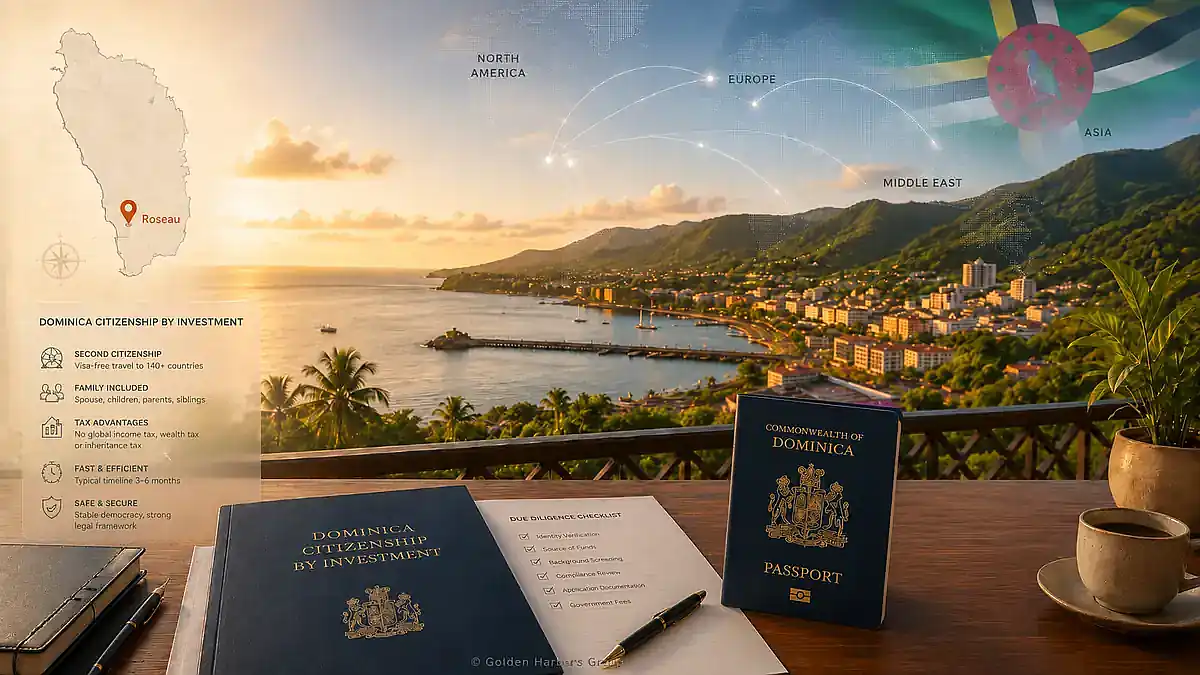
Dominica citizenship by investment in 2026 starts at USD 200,000 through the Economic Diversification Fund and requires no prior residency in the country. The program, established in 1993 and administered by the Citizenship by Investment Unit (CBIU), grants lifetime citizenship, permits full dual nationality, and provides visa-free or visa-on-arrival access to 145 countries as of the 2026 Henley Passport Index.
Key Takeaways
- Minimum investment: USD 200,000 to the Economic Diversification Fund (EDF) or USD 200,000 in approved real estate.
- Family-of-four EDF contribution: USD 250,000 plus government fees.
- No residency requirement before, during, or after citizenship; the process is fully remote.
- Visa-free or visa-on-arrival access to 145 countries (Henley Passport Index 2026, rank 29).
- UK visa-free access was revoked on July 19, 2023; Schengen Area access remains.
- Dual citizenship is permitted; no need to renounce existing nationality.
- Processing time: 6 to 9 months from full submission to certificate of naturalisation.
- Mandatory virtual interview for every applicant aged 16 and over.
- ECCIRA regional regulatory framework was passed in the National Assembly of St Kitts on October 17, 2025 and applies across Caribbean CBI programmes.
Quick Facts: Dominica CBI Program 2026
Why Is Dominica a Strong Choice for Citizenship by Investment in 2026?
Dominica Citizenship by Investment has operated for over three decades, making it one of the most established routes to a Caribbean second passport. For 2026 applicants, three developments matter: the Eastern Caribbean Citizenship by Investment Regulatory Authority (ECCIRA) agreement, which St Kitts and Nevis passed in its National Assembly on October 17, 2025 and which tightens due diligence standards across all five Caribbean programmes; a clarified restricted-nationalities framework; and a passport that reached its highest-ever Henley ranking at 29th globally with access to 145 destinations.
The programme is governed by the Dominica Citizenship Act and administered by the Citizenship by Investment Unit, which conducts multi-layer background screening including mandatory virtual interviews for all applicants aged 16 and over. Screening is carried out in collaboration with independent third-party firms from the United States and the United Kingdom.
What Is the Legal Framework Behind the Dominica CBI Program?
The Citizenship Act, first enacted in 1978 following independence, forms the constitutional basis for how Dominican nationality is acquired and maintained. It defines pathways including birth, descent, marriage, naturalization, and citizenship by investment, and delegates authority over the investment route to the CBIU.
Dominica Citizenship Act
The Act establishes the rights and obligations of Dominican citizens and defines the eligibility criteria for each acquisition pathway. Amendments introduced after the CBI programme launched in 1993 clarified the role of authorised agents, the mandatory due diligence process, and the rights conferred by naturalization certificates. The pathways the Act recognises are:
- Birth. Citizenship is granted to individuals born in Dominica to at least one Dominican parent.
- Descent. Citizenship may be acquired by individuals born outside Dominica with at least one Dominican parent.
- Marriage. Foreign spouses of Dominican citizens may apply for naturalization subject to residency and other requirements.
- Naturalization. Foreign nationals who have legally resided in Dominica for a specified period may apply for citizenship subject to residency and character requirements.
- Citizenship by Investment. Foreign investors may acquire citizenship by making an economic contribution to the country, with the Act providing the legal foundation, eligibility criteria, and authority responsible for granting citizenship.
Citizenship by Investment Unit
The Citizenship by Investment Unit (CBIU) receives, reviews, and approves applications. It does not accept submissions directly from individuals; all applications must go through an authorised agent listed on the CBIU register. Its responsibilities include:
- Application Processing. Reviewing and evaluating all applications for compliance with programme requirements.
- Due Diligence and Security Checks. Conducting background checks through international screening firms.
- Programme Promotion and Regulation. Maintaining the global reputation of the programme and ensuring competitive positioning.
- International Cooperation. Working with financial and legal institutions worldwide on anti-money laundering and counter-terrorism financing.
- Restricted Nationalities. Maintaining a public list of nationalities currently ineligible. As of 2026 these include Belarus, Russia, Northern Iraq, and Yemen. Iranian nationals are accepted but subject to enhanced due diligence and higher fees.
What Investment Options Does Dominica Citizenship by Investment Offer?
Two pathways exist. The Economic Diversification Fund is a non-refundable government contribution that supports infrastructure, healthcare, education, and climate-resilience projects. The real estate route involves purchasing an equity share in a government-approved development project, with a mandatory holding period. Both routes lead to identical citizenship outcomes.
Citizenship by Donation: The Economic Diversification Fund
The EDF is the simpler and lower-cost-at-entry route. It requires a non-refundable contribution of USD 200,000 for a single applicant. A family of four (main applicant, spouse, and two dependents) requires USD 250,000. There is no property to manage, no holding period, and no exit strategy to plan. Government fees, including due diligence, processing, interview, and certificate fees, are added on top of the contribution.
Citizenship by Investment in Real Estate
The real estate route requires a minimum investment of USD 200,000 in a government-approved development, typically a fractional share in a luxury eco-resort or managed residential project. The property must be held for at least three years before resale; if resold to another CBI applicant, the hold period extends to five years. The route offers potential rental income and capital appreciation, though returns are not guaranteed and depend on the specific project and market conditions. Additional government fees apply on top of the USD 200,000 threshold and vary by family size.
Fund vs Real Estate: Which Route Should You Choose?
The EDF route is generally preferred by families prioritising simplicity and lowest total cost. The real estate route suits investors who want an underlying asset on the balance sheet or who are drawn to Dominica's expanding tourism sector, including the planned new international airport. The table below summarises the structural differences.
| Factor | EDF Contribution | Real Estate Investment |
|---|---|---|
| Minimum investment (single) | USD 200,000 | USD 200,000 |
| Minimum investment (family of 4) | USD 250,000 | USD 200,000 (government fees vary) |
| Refundable | No, non-refundable donation | Potentially, after the 3-year hold |
| Holding period | Not applicable | 3 years (5 years if resold to a CBI applicant) |
| Potential financial return | None | Rental income or capital gain, not guaranteed |
| Complexity | Low, no asset to manage | Medium, property due diligence required |
| Family eligibility | Spouse, children, parents, grandparents | Spouse, children, parents, grandparents |
| Citizenship outcome | Identical | Identical |
How Much Does Dominica Citizenship by Investment Cost in 2026?
The total cost has two layers: the investment itself, and a set of mandatory government fees payable regardless of route. The tables below set out the current official fee schedule.
| Economic Diversification Fund Route | Cost (USD) |
|---|---|
| Non-Refundable Contribution | |
| Single Applicant | $200,000 |
| Main Applicant and Spouse | $200,000 |
| Family of Four (Main Applicant + Spouse + Two Dependents) | $250,000 |
| Each Additional Dependent | Additional fees may apply |
| Government Fees | |
| Processing Fee (per application) | $1,000 |
| Due Diligence Fee (Main Applicant) | $7,500 |
| Due Diligence Fee (Dependents aged 16 or above) | $4,000 each |
| Certificate of Naturalisation Fee (per person) | $500 |
| Mandatory Interview Fee (per person aged 16 or over) | $1,000 |
| Real Estate Route | Cost (USD) |
|---|---|
| Investment Amount | |
| Minimum Investment in Government-Approved Real Estate | $200,000 |
| Government Fees | |
| Single Applicant | $75,000 |
| Main Applicant and up to Three Dependents | $100,000 |
| Each Additional Dependent under 18 | $25,000 |
| Each Additional Dependent aged 18 or over | $50,000 |
| Additional Fees | |
| Processing Fee (per application) | $1,000 |
| Due Diligence Fee (Main Applicant) | $7,500 |
| Due Diligence Fee (Dependents aged 16 or above) | $4,000 each |
| Certificate of Naturalisation Fee (per person) | $500 |
| Mandatory Interview Fee (per person aged 16 or over) | $1,000 |
Agent service fees, legal fees, bank transfer charges, and notarisation costs are additional and vary by provider. For a personalised total-cost estimate based on your family configuration, speak with a licensed authorised agent.
What Are the Benefits of Dominica Citizenship by Investment?
Visa-Free Global Mobility
Dominican passport holders enjoy visa-free or visa-on-arrival access to 145 countries and territories as of the 2026 Henley Passport Index, where Dominica ranks 29th globally. Access covers the entire Schengen Area, Singapore, Hong Kong, South Korea, and Brazil. The United Kingdom revoked visa-free access for Dominican passport holders on July 19, 2023, and a UK visitor visa is now required; Ireland followed in March 2024. Applicants with active UK or Irish business ties should factor this into their mobility planning.
Favourable Tax Environment
Dominica levies no taxes on foreign-sourced income, capital gains, inheritance, or net wealth for residents or citizens who are not ordinarily resident in Dominica. Individuals who establish tax residency in Dominica should verify their full obligations with a local tax advisor, as domestic-source income rules apply separately.
No Residency Requirement
The programme imposes no physical presence requirement at any stage. Applicants never need to visit Dominica before, during, or after the application. The entire process runs through an authorised agent, with the mandatory interview conducted virtually.
Inclusive Family Application
A single application can cover the main applicant, spouse, dependent children up to age 30, and dependent parents and grandparents over 55 who are substantially supported by the main applicant. Siblings are not currently eligible. Each dependent aged 16 or over also requires a separate due diligence check and interview.
Dual Citizenship Permitted
Dominica recognises dual citizenship without restriction. You retain your original nationality and acquire Dominican citizenship alongside it. The grant is not automatically reported to your home country, although some countries' own laws require disclosure on their end.
Lifetime Citizenship With Generational Transfer
Dominican citizenship obtained by investment is permanent. It can be passed down to future generations through descent. The passport is valid for ten years and is renewable indefinitely.
Caribbean Community Rights
Dominican citizens hold rights of movement within CARICOM (Caribbean Community) member states and OECS (Organisation of Eastern Caribbean States) countries with free-movement agreements, providing additional regional flexibility.
Stable Political Environment
Dominica maintains a parliamentary democracy with an independent judiciary. The Commonwealth of Dominica is a member of the United Nations, the Commonwealth of Nations, and CARICOM.
Access to an Eco-Tourism Growth Market
Dominica brands itself the Nature Isle of the Caribbean. The government has committed to a resilient-island development strategy and a planned new international airport intended to expand direct air access and support real estate tourism demand.
Who Is Eligible for the Dominica Citizenship Program?
The eligibility criteria are deliberately straightforward. The primary requirements are age, clean criminal record, verifiable source of funds, and good health. There is no language requirement and no educational requirement.
| Criterion | Requirement |
|---|---|
| Age | Main applicant must be 18 or older |
| Criminal record | Clean background check across all countries of citizenship, birth, and long-term residence |
| Health | Good health; medical questionnaire completed by a licensed practitioner (Form D3) |
| Source of funds | Legitimate and verifiable; sworn affidavit and financial documents required |
| Nationality restrictions | Nationals of Belarus, Russia, Northern Iraq, and Yemen are ineligible; Iranian nationals subject to enhanced due diligence |
| Character | No history of visa or immigration refusals indicating a security or integrity concern |
What Documents Are Required for a Dominica CBI Application?
The CBIU publishes the full required-documents list on its official website. The core set includes:
- Form D1 (Disclosure Form), capturing personal and financial information.
- Form D2 (Fingerprint and Photograph Verification Form), completed before a registered fingerprinting officer.
- Form D3 (Medical Questionnaire and Certificate), completed by a licensed medical practitioner.
- Form D4 (Investment Agreement), for the main applicant only.
- Sale and Purchase Agreement, for applicants choosing the real estate route.
- Application Form 12, two notarised copies per applicant.
- Colour copies of all passports held, current and expired.
- Certified birth certificate.
- Marriage certificate or divorce certificate if applicable.
- Police clearance certificates from country of birth, country of citizenship, country of residence, and any country where the applicant has lived more than six months in the past ten years.
- Bank reference letter from a recognised financial institution.
- Professional reference letter from a lawyer, accountant, or equivalent.
- Affidavit of source of funds with supporting financial documentation.
- Twelve months of bank statements.
- Employment letter or audited business financial statements.
- Eight passport-sized photographs meeting current passport standards.
All documents must be in English or accompanied by a certified English translation. Notarisation and apostille requirements vary by country of origin; consult your authorised agent for jurisdiction-specific guidance.
How Long Does the Dominica CBI Process Take?
The current realistic processing window is 6 to 9 months from full application submission to issuance of the certificate of naturalisation. The process has two main phases.
Phase 1. Due Diligence and Pre-Approval. This first step takes approximately 8 to 12 weeks. During this period, the CBIU and its third-party screening partners verify the applicant's background through international law enforcement databases, financial intelligence checks, and the mandatory virtual interview. Upon successful completion, the applicant receives pre-approval.
Phase 2. Main Application and Investment Completion. The second phase typically takes an additional 6 to 8 weeks. The applicant completes the required investment, either through the EDF contribution or the real estate purchase. Once verified, final approval is granted and the Certificate of Naturalisation is issued. Dominican passport issuance follows separately and takes 2 to 4 weeks.
Factors that extend timelines include incomplete documentation, complex financial backgrounds requiring additional explanation, high application volumes at the CBIU, and additional screening for applicants flagged under enhanced due diligence.
How to Apply for Dominica Citizenship by Investment?
Step 1. Engage an Authorised Marketing Agent
Direct submissions to the CBIU from individuals are not allowed. All applications must be submitted through an authorised agent registered with the CBIU. The agent reviews eligibility, advises on the optimal investment route, and manages all communication with the CBIU.
Step 2. Prepare Documentation
Complete all required forms, commission the medical examination, collect police clearances from every required jurisdiction, and assemble financial documentation. Ensure all documents are notarised and translated where required. This stage typically takes four to eight weeks depending on how quickly police clearances can be obtained.
Step 3. Submit Application
Your authorised agent submits the complete application package to the CBIU. The CBIU issues an acknowledgement of receipt and assigns a case reference number. Any requests for additional information are routed through the agent.
Step 4. Undergo Due Diligence and Mandatory Interview
The CBIU, working with its third-party screening firms, conducts background checks on all applicants aged 16 and over. Every applicant in that age bracket also attends a mandatory virtual interview via a secure government platform. The interview fee is USD 1,000 per person. Upon satisfactory completion, the CBIU issues a pre-approval letter.
Step 5. Complete the Investment
Following pre-approval, the main applicant completes the investment, either by wiring the EDF contribution to the designated government account or by executing the sale and purchase agreement for the approved real estate project. Proof of payment is submitted to the CBIU.
Step 6. Receive the Certificate of Naturalisation
After investment verification, the CBIU issues the Certificate of Naturalisation. This document constitutes official proof of Dominican citizenship and is required for the passport application.
Step 7. Apply for Your Dominican Passport
With the Certificate of Naturalisation in hand, apply for a Dominican passport at the relevant embassy, high commission, or consular office. The passport is valid for ten years and renewable indefinitely.
How Does Dominica Compare to Other Caribbean CBI Programs?
Five Caribbean nations operate government-approved citizenship by investment programmes. Understanding where Dominica sits on cost, passport strength, and programme structure helps applicants shortlist the right option. For broader cluster context, see the Caribbean passport comparison guide and the Caribbean real estate and citizenship guide.
← Swipe →
| Feature | Dominica | St. Kitts & Nevis | Antigua & Barbuda | Grenada | St. Lucia |
|---|---|---|---|---|---|
| Fund donation (single) | $200,000 | $250,000 | $230,000 | $235,000 | $240,000 |
| Real estate minimum | $200,000 | $400,000 | $300,000 | $270,000 | $300,000 |
| Visa-free / VOA access | 145 countries | 150+ countries | 151 countries | 147 countries | 145+ countries |
| US E-2 Visa treaty | No | Yes | No | Yes | No |
| Processing time | 6 to 9 months | 4 to 6 months | 6 to 8 months | 6 to 8 months | 6 to 9 months |
| Residency requirement | None | None | 5 days within 5 years | None | None |
| Real estate hold period | 3 years | 5 to 7 years | 5 years | 5 years | 5 years |
| Siblings eligible | No | No | Yes | Yes | No |
| Programme established | 1993 | 1984 | 2013 | 2013 | 2015 |
Dominica stands out on two dimensions: the lowest total EDF cost for a single applicant among the five programmes, and the second-oldest programme with over three decades of operational track record. Grenada and St. Kitts offer the E-2 Treaty advantage for applicants seeking a path to US business residency. Antigua and Barbuda suits large families wanting to include siblings.
What Are the Main Challenges in a Dominica CBI Application?
1. Documentation scope and authentication. The application requires police clearances from multiple jurisdictions, certified translations, notarised affidavits, and 12 months of financial records. Any error or missing apostille causes delay. Start document collection eight to ten weeks before the intended submission date.
2. Source-of-funds scrutiny. The CBIU examines the origin of investment funds in detail. Applicants with complex corporate structures, multi-jurisdiction assets, or business interests in higher-risk sectors should expect additional documentation requests. Prepare a clear, well-organised source-of-funds narrative supported by audited accounts and a lawyer's opinion.
3. The mandatory interview. Since July 2023, all applicants aged 16 and over attend a virtual interview through a secure CBIU platform. The interview assesses the consistency of information provided in the application. Coaching from an experienced authorised agent before the interview is advisable.
4. Selecting the right investment project. Not all approved real estate projects carry the same risk profile. Investors should conduct independent due diligence on the developer, the project's construction timeline, the management company's rental track record, and the resale market depth before committing.
5. Nationality and geopolitical considerations. Applicants from countries on enhanced due diligence lists face higher fees and longer screening timelines. Restricted nationalities are entirely ineligible. Verify eligibility with an authorised agent before submitting documents or fees.
How Golden Harbors Helps With Dominica Citizenship
Golden Harbors works with applicants to the Dominica Citizenship by Investment Programme through licensed authorised agents. Our team structures the application, manages document preparation, prepares applicants for the mandatory CBIU interview, and coordinates correspondence with the CBIU through to certificate issuance and passport application. We also advise on the EDF-versus-real-estate decision in the context of your broader asset and tax structure. For families comparing programmes across the Caribbean cluster, we map programmes side by side before any investment commitment is made. See the Dominica programme page for a structured overview and additional resources.
Frequently Asked Questions
Is Dominica the Same as the Dominican Republic?
No. Dominica is a small island nation in the Lesser Antilles with English as its official language and a population of roughly 70,000. The Dominican Republic occupies the eastern half of the island of Hispaniola in the Greater Antilles, has Spanish as its official language, and has a population of over 11 million. The two countries share a similar name but are entirely separate nations with different governments, legal systems, and citizenship programmes.
What Is the Minimum Investment for Dominica Citizenship in 2026?
The EDF donation starts at USD 200,000 for a single applicant, rising to USD 250,000 for a family of four. Total cost for a single applicant on the EDF route, including government fees, is approximately USD 210,500 before agent and ancillary fees. The real estate route requires USD 200,000 minimum plus separate government fees scaled by family size.
Does Dominica Allow Dual Citizenship?
Yes. Dominica permits dual citizenship with no restrictions. You keep your original nationality and acquire Dominican citizenship alongside it. The Dominican government does not automatically notify your home country, though your home country's own laws may require you to declare it.
How Many Countries Can I Visit Visa-Free With a Dominica Passport?
Dominican passport holders enjoy visa-free or visa-on-arrival access to 145 countries as of the 2026 Henley Passport Index, where Dominica ranks 29th globally. Access includes the full Schengen Area, Singapore, Hong Kong, South Korea, and Brazil. The United Kingdom and Ireland are no longer visa-free; visitor visas must be obtained in advance.
Do I Have to Live in Dominica to Maintain My Citizenship?
No. There is no residency requirement to obtain or to keep Dominican citizenship by investment. You may live anywhere in the world and still hold a valid Dominican passport. You gain the right to live, work, and study in Dominica but are not obliged to exercise it.
Is a Personal Interview Required for Dominica Citizenship?
Yes. Since July 2023, all applicants aged 16 and over are required to attend a mandatory virtual interview conducted via the CBIU's secure platform. The fee is USD 1,000 per person. Family members may attend simultaneously where technically feasible; missed sessions are rescheduled.
Can I Include Family Members in My Dominica CBI Application?
Yes. The programme covers the main applicant's spouse, unmarried dependent children up to age 30, and dependent parents and grandparents aged 55 and over who are substantially supported by the main applicant. Siblings are not currently eligible under Dominica's programme. Each dependent who is 16 or over also requires a separate due diligence check and interview.
Should I Choose the EDF Contribution or Real Estate Investment?
The EDF is lower in total cost for families and simpler to execute, with no property to manage and no holding period. The real estate route offers a potential return through rental income and capital appreciation and leaves an underlying asset on your balance sheet. The right answer depends on investment horizon, appetite for a managed asset, and total cost after family-size fees are modelled.
Ready to move from research to a concrete Dominica citizenship plan? Book a consultation call with a Golden Harbors advisor and we will map the right investment structure, model the total cost for your family size, and walk you through every step of the CBIU process.
About the Author. Victoria Cold is a European Attorney at Golden Harbors specialising in second citizenship and global residence programs across the Caribbean, Europe, and the Middle East. She advises HNW individuals and families on programme selection, investment structuring, and application strategy.
Last reviewed: May 2026
Disclaimer: This article is for informational purposes only and does not constitute legal, tax, or immigration advice. Program terms, tax rates, and regulatory requirements change frequently.
There are Always Options to EXPAND YOUR BOUNDARIES! Let's Discuss Yours
Every client is unique
Every case requires an individual approach and solution. Our years of experience in the industry allow us to provide both.
We will answer all your questions and provide detailed information about the available second passport and residency programs to help you make the right choice.
Victoria
Lead Attorney at Golden Harbors

Victoria
Lead Attorney at Golden Harbors
Read also

