Singapore Business Visa

Offshore services
Bundled Services
Top Citizenship & Residency
Articles & Research
About Us
Contact Us


.svg)


Trusted by Global Clients & Partners


July 9, 2026
6
min read

Chile Temporary Resident Visa 2026: Requirements and How to Apply

.svg)


2.2K

2.2K
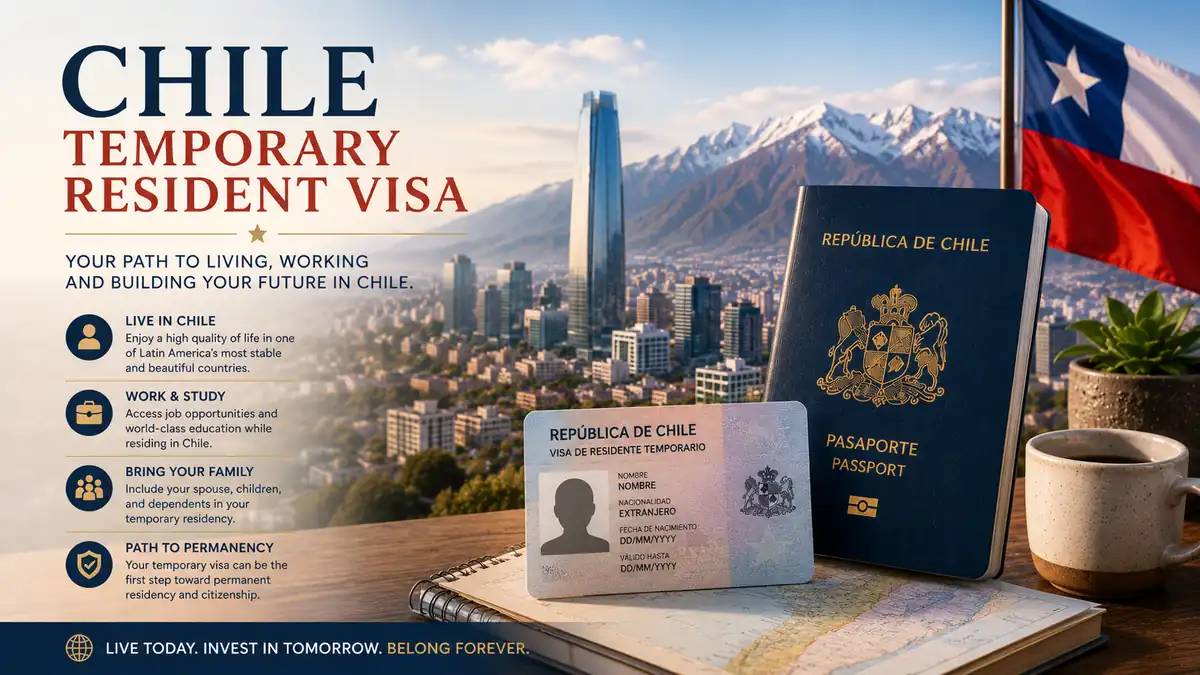
The Chile temporary resident visa, known as the Residencia Temporal, lets a foreigner live in Chile for up to 2 years, renewable, and is the standard route to permanent residence. It is granted under Law 21.325 and Decree 177 of 2022, managed by SERMIG, and is applied for online from outside Chile.
Key Takeaways
- The temporary resident visa (Residencia Temporal) is valid for up to 2 years and is renewable, then leads to permanent residence.
- It is not one visa but a framework of subcategories under Decree 177 of 2022, covering family ties, work, investment, retirees, and remote workers.
- Applications are filed online through the SERMIG digital portal, and as a rule from outside Chile before you travel.
- Core documents are common to every subcategory: a valid passport, a criminal record certificate, and apostilled, translated paperwork.
- After 12 or 24 months of temporary residence, depending on subcategory, you can apply for permanent residence, and citizenship follows later.
Quick Facts: Chile Temporary Resident Visa 2026
Permit name: Residencia Temporal
Validity: Up to 2 years, renewable
Legal basis: Law 21.325 and Decree 177 of 2022
Authority: SERMIG (National Migration Service)
Where to apply: Online, from outside Chile
Entry window: 90 days to enter after approval
Path to permanent residence: After 12 or 24 months
Path to citizenship: After 5 years of residence
Foreign-income tax: Exempt for 3 years, extendable to 6
Digital nomad visa: No standalone visa in 2026
What Is the Chile Temporary Resident Visa?
The temporary resident visa is Chile's main permit for foreigners who want to live in the country for more than a short visit. In Spanish it is the Residencia Temporal, and it is the middle step in a clear sequence: temporary residence first, then permanent residence, then citizenship.
Its legal foundation is the Migration and Aliens Act, Law 21.325, which took effect in 2022, together with Decree 177 of 2022, which defines the subcategories. The whole system is run by the Servicio Nacional de Migraciones (SERMIG). For the full picture of how this fits the wider system, see our Chile residency guide.
What Are the Main Visa Subcategories?
There is no single temporary visa. Decree 177 sets out a list of subcategories, each with its own qualifying conditions. Most applicants use one of a handful of common routes.
← Swipe →
| Subcategory | Who It Is For | Core Evidence |
|---|---|---|
| Family ties | Spouse, partner, parent, or child of a Chilean or a permanent resident | Proof of the family relationship |
| Work contract | Foreigners hired by a Chilean company | Signed employment contract or offer |
| Investor | Foreigners investing in productive activity in Chile | Investment plan and source of funds |
| Rentista or jubilado | People living on stable passive income or a pension | Proof of regular income or pension |
| Remunerated activities | Freelancers and contractors invoicing foreign clients | Service contract and income records |
| Student | Foreigners enrolled in a Chilean institution | Proof of enrolment |
| Source: Decree 177 of 2022 and SERMIG. The list is not exhaustive; Decree 177 defines additional subcategories. Requirements are set per subcategory and can change. | ||
Two points are worth noting. Chile has no standalone digital nomad visa in 2026, so remote workers generally use the remunerated-activities route with a foreign service contract. And the investor route is built around a productive investment in Chile, covered in detail in our Chile residency by investment guide.
What Are the Requirements?
Each subcategory adds its own evidence, but a common documentary core runs through all of them. Plan for these first, because gathering and legalizing them takes the most time.
| Requirement | Detail |
|---|---|
| Valid passport | With sufficient remaining validity, plus a clear photo page |
| Criminal record certificate | From your country of origin and any country lived in for more than 5 years |
| Apostille or legalization | Foreign documents must be apostilled or legalized to be accepted |
| Sworn translation | Documents not in Spanish or English translated by a sworn translator |
| Proof of means or purpose | Income, pension, contract, investment, or enrolment per subcategory |
| Photograph | Recent passport-style photo in the format SERMIG specifies |
| Source: SERMIG application requirements under Law 21.325 and Decree 177 of 2022. Subcategory-specific documents are additional. Confirm the current checklist on the SERMIG portal before filing. | |
Income thresholds for the rentista, jubilado, and remote-work routes are not published as a single official figure. SERMIG assesses whether income is stable and sufficient, so treat any amount you see quoted as indicative rather than a fixed legal floor.
How Do You Apply for the Visa?
The process is fully digital and, as a rule, completed before you travel. Chile generally does not allow a tourist to switch to residence from inside the country, so the application starts from abroad.
- Create an account on the SERMIG Portal de Tramites Digitales (digital procedures portal).
- Complete the online form for temporary residence from outside Chile and select your subcategory.
- Upload the core documents plus the subcategory-specific evidence, all apostilled and translated where required.
- Pay the visa fee (arancel) for your subcategory and nationality when prompted.
- Wait for SERMIG to assess the application remotely, then, once approved, enter Chile within 90 days.
- After arrival, within 30 days register with the Policia de Investigaciones (PDI) and obtain your Chilean identity card (cedula de identidad) at the Registro Civil.
Applying from within Chile is possible only in narrow cases under Article 69 of Law 21.325, such as a family bond with a Chilean or permanent resident, dependents of a temporary resident, or humanitarian situations.
How Long Is It Valid and What Comes Next?
A temporary resident visa runs for up to 2 years and can be renewed. It is a step, not a destination: holding it for the qualifying period opens the door to permanent residence, and from there to citizenship.
| Stage | Timing and Note |
|---|---|
| Temporary residence | Up to 2 years, renewable, under your chosen subcategory |
| Permanent residence | Available after 12 or 24 months of temporary residence, depending on subcategory |
| Citizenship | By naturalization after 5 years of residence in Chile |
| Source: Law 21.325 of Migracion y Extranjeria and Decree 177 of 2022. Qualifying periods depend on the subcategory held. | |
The later steps have their own guides: citizenship by naturalization and the broader Chilean citizenship overview. Once you naturalize, the Chilean passport follows.
How Much Does the Visa Cost?
There is no single price. The temporary visa fee (arancel) set by SERMIG depends on two things: the subcategory you apply under and your nationality, because Chile applies reciprocity, charging citizens of some countries the same fees their country charges Chileans.
Beyond the visa fee itself, budget for the surrounding costs that apply to most applicants:
- Criminal record certificates and their apostille or legalization.
- Sworn translation of any document not in Spanish or English.
- The Chilean identity card, issued after arrival, which has its own separate fee.
- Renewal fees if you extend the temporary residence before moving to permanent residence.
Because the fee schedule is updated periodically and varies by nationality, confirm the exact amount for your subcategory on the SERMIG portal before applying.
What About Taxes for New Residents?
Chile offers a notable incentive for new arrivals. A foreigner who becomes a Chilean tax resident is taxed only on Chilean-source income for the first 3 years, and that exemption on foreign-source income can be extended by a further 3 years on application to the tax authority, the Servicio de Impuestos Internos.
Tax residence is a separate question from immigration status and generally turns on how much time you spend in Chile and where your economic life sits. This article is not tax advice, and cross-border tax planning should be reviewed with a qualified adviser before you rely on any treatment.
Can You Apply From Inside Chile?
As a general rule, no. Under the 2022 Migration Act, a person who enters Chile on a tourist permit (Permanencia Transitoria) cannot change to a residence permit from within the country. The application is meant to be filed from abroad through the SERMIG portal before you travel.
The exceptions are narrow and set out in Article 69 of Law 21.325. They include people with a family bond to a Chilean citizen or a permanent resident, those applying as dependents of a temporary resident, humanitarian cases, and a small set of situations qualified by the authorities. If you are already in Chile as a tourist and none of these apply, the correct path is to leave and apply from outside.
Common Mistakes to Avoid
Most refused or delayed applications come down to a handful of avoidable errors:
- Entering Chile as a tourist and expecting to switch to residence from inside the country.
- Missing a criminal record certificate from a country you lived in for more than 5 years.
- Submitting foreign documents without the required apostille or sworn translation.
- Choosing the wrong subcategory, such as the employee route when a foreign service contract fits better.
- Letting the 90-day entry window lapse after approval, which can invalidate the visa.
Frequently Asked Questions
How Long Does the Chile Temporary Resident Visa Last?
The temporary resident visa (Residencia Temporal) is valid for up to 2 years and is renewable. The exact term depends on the subcategory granted. After holding it for 12 or 24 months, depending on the subcategory, the holder can apply for permanent residence, and citizenship by naturalization becomes available after 5 years of residence.
Can I Apply for the Visa While in Chile as a Tourist?
Generally no. Under Law 21.325, a tourist cannot switch to a residence permit from inside Chile. The application is filed from abroad through the SERMIG portal before travel. Narrow exceptions in Article 69 cover family bonds with Chileans or permanent residents, dependents of a temporary resident, and humanitarian cases.
Does Chile Have a Digital Nomad Visa?
Chile has no standalone digital nomad visa in 2026. Remote workers generally apply under the remunerated-activities subcategory of temporary residence, using a service contract with a foreign client rather than an employment relationship. A salaried employee of a foreign company without a Chilean presence usually does not qualify under that route.
How Do I Apply for the Temporary Resident Visa?
Create an account on the SERMIG digital portal, complete the temporary residence form for applicants outside Chile, and select your subcategory. Upload your passport, criminal record certificate, and subcategory evidence, all apostilled and translated where required, then pay the fee. Once approved, you have 90 days to enter Chile.
What Documents Do I Need?
Every subcategory requires a valid passport, a criminal record certificate from your country of origin and any country lived in for over 5 years, and proof of means or purpose. Foreign documents must be apostilled or legalized, and anything not in Spanish or English must be translated by a sworn translator.
How Much Income Do I Need for the Rentista or Retiree Visa?
Chile does not publish a single official income floor for the rentista or jubilado routes. SERMIG assesses whether your income or pension is stable and sufficient to support you. Any figure quoted online is indicative practice rather than a fixed legal requirement, so confirm current expectations before applying.
How Golden Harbors Helps
Golden Harbors advisors match each client to the right temporary residence subcategory, which is the decision that most often determines whether an application succeeds. The team builds the document set, coordinates apostilles and sworn translations, prepares the SERMIG submission from abroad, and sequences the move from temporary residence to permanent residence and, in time, citizenship, so each stage sets up the next rather than creating a dead end.
Sergey Voinich, Founder and Managing Partner at Golden Harbors, notes: "The single biggest predictor of a clean Chile file is subcategory choice. People default to the work-contract route when a foreign service contract actually fits their situation, and unwinding that after filing costs far more time than getting it right up front."
Ready to move from research to action? Book a general consultation call with Golden Harbors, global mobility experts who walk you through the right Chile temporary residence subcategory, the documents, and the timeline for your situation.
Book a CallAbout the Author
Sergey Voinich, Founder and Managing Partner at Golden Harbors, is a foreign attorney specializing in international, patent, and copyright law, with over 20 years of experience across CIS finance and US technology sectors. He has held roles at PayPal, eBay, and Amazon and is certified by the Investment Migration Council. At Golden Harbors, he leads a team focused on global citizenship and residency solutions for entrepreneurs and family offices.
Last reviewed: July 2026.
Disclaimer: This article is for informational purposes only and does not constitute legal, tax, or immigration advice. Program terms, tax rates, and regulatory requirements change frequently. Verify current requirements before acting.
There are Always Options to EXPAND YOUR BOUNDARIES! Let's Discuss Yours
Every client is unique
Every case requires an individual approach and solution. Our years of experience in the industry allow us to provide both.
We will answer all your questions and provide detailed information about the available second passport and residency programs to help you make the right choice.
Victoria
Lead Attorney at Golden Harbors

Victoria
Lead Attorney at Golden Harbors
Read also

