Singapore Business Visa

Offshore services
Bundled Services
Top Citizenship & Residency
Articles & Research
About Us
Contact Us


.svg)


Trusted by Global Clients & Partners


July 31, 2026
6
min read

Turkey Citizenship by Investment 2026: Cost, Process, and Timeline

.svg)


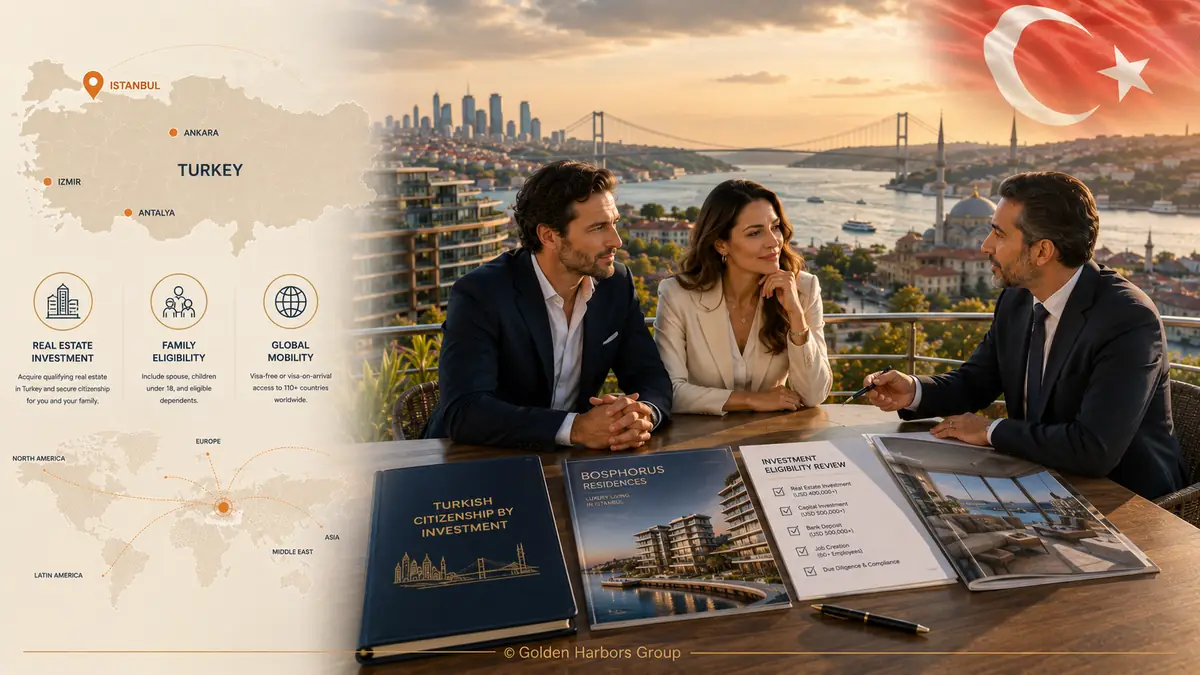
Turkey citizenship by investment grants a full passport for a US$400,000 real estate purchase held for three years, or US$500,000 through alternative routes, as of July 2026. Processing runs about 3 to 6 months, there is no residency requirement, and a spouse and children under 18 are included. The passport excludes Schengen but opens a US E-2 pathway.
Key Takeaways
- Turkey grants full citizenship for a US$400,000 real estate purchase held for three years, or US$500,000 through several alternative routes, as of July 2026.
- The real estate route accounts for the large majority of approved files because the property can be sold and the capital recovered after the three-year hold.
- Processing typically runs 3 to 6 months for a clean file and up to 6 to 12 months end to end, with final approval by presidential decree.
- There is no residency requirement, no language test, and dual citizenship is permitted. A spouse and children under 18 are included at no extra investment.
- The Turkish passport does not include Schengen visa-free access, but Turkey is a US E-2 treaty country, so citizens can later apply for the E-2 investor visa.
Quick Facts: Turkey Citizenship by Investment 2026
| Minimum investment | US$400,000 real estate, or US$500,000 alternative routes |
| Holding period | 3 years (no-sale annotation on the title deed) |
| Processing time | About 3 to 6 months for a clean file |
| Final approval | Presidential decree |
| Residency requirement | None |
| Language test | None |
| Dual citizenship | Permitted |
| Family included | Spouse and children under 18, no extra investment |
| Visa-free access | About 110 to 120 destinations; no Schengen |
| US pathway | E-2 investor visa eligibility after 3 years of citizenship |
| Programme launched | 2017 (threshold raised to US$400,000 in 2022) |
What Is Turkey Citizenship by Investment?
Turkey citizenship by investment is a direct route to a Turkish passport in exchange for a qualifying investment, most often a real estate purchase of at least US$400,000. Turkey launched the programme in 2017 and it has become the highest-volume citizenship-by-investment route tied to a G20 economy. Unlike Caribbean donation programmes, the Turkish route is built around recoverable assets, which is its central appeal.
The programme grants full citizenship, not residency. The applicant, their spouse, and their children under 18 receive Turkish passports together, with the same rights as any citizen, including the right to live, work, and pass citizenship to future children. There is no requirement to live in Turkey before or after naturalisation.
How Much Does Turkey Citizenship by Investment Cost in 2026?
The minimum is US$400,000 for the real estate route or US$500,000 for the alternative routes, as of July 2026. Real estate dominates because the property can be sold after three years, so the capital is recoverable rather than spent. The table sets out every qualifying route and whether the capital comes back.
← Swipe →
| Route | Minimum | Holding period | Capital recoverable? | Notes |
|---|---|---|---|---|
| Real estate | US$400,000 | 3 years | Yes, after 3 years | Valuation set by an SPK-licensed appraiser, not the asking price; dominant route |
| Bank deposit | US$500,000 | 3 years | Yes, after 3 years | Held in a government-approved Turkish bank |
| Government bonds | US$500,000 | 3 years | Yes, after 3 years | Purchased and held for the commitment period |
| Investment fund shares | US$500,000 | 3 years | Yes, after 3 years | Shares in an approved Turkish fund |
| Fixed capital | US$500,000 | 3 years | Depends on venture | Confirmed by the Ministry of Industry and Technology |
| Job creation | 50 jobs | Ongoing | Not applicable | Confirmed by the Ministry of Labour |
These figures cover the qualifying investment only. Government charges, legal fees, translation and notarisation, and due diligence costs are additional and depend on the file. The threshold has risen over time, from US$1,000,000 at launch in 2017 to US$250,000 in 2018 and then US$400,000 in June 2022, so investors should treat the current figure as subject to future change.
What Are the Requirements to Qualify?
The core requirements are a qualifying investment, a clean background, and a commitment to hold the investment for three years. The applicant must be at least 18 and prove the lawful source of funds. There is no language test and no minimum stay.
For the real estate route, three technical rules decide eligibility. First, the value is set by an appraiser licensed by the Capital Markets Board (SPK) and registered at the Land Registry, not by the asking price. Second, payment must move through a Turkish bank to generate a Foreign Exchange Purchase Certificate. Third, a three-year no-sale annotation is placed on the title deed. Miss any of these and the file can be rejected.
- Applicant aged 18 or older with a clean criminal record
- Qualifying investment at or above the route threshold, by valuation not asking price
- Documented source of funds and payment through the Turkish banking system
- Commitment to the three-year holding period, annotated on the title deed for real estate
- Eligible nationality; citizens of Armenia, Cuba, Nigeria, North Korea, and Cyprus are generally excluded
What Does the Process and Timeline Look Like?
The process runs in a fixed sequence and takes about 3 to 6 months for a clean file, longer for self-managed applications. The final step is a presidential decree, which is the moment citizenship is granted.
Step 1. Confirm Eligibility and Prepare
Verify the investor's nationality is eligible, obtain a Turkish tax number, and open a Turkish bank account. Compliance documentation and clear, traceable fund movements matter more under the tightened 2026 checks.
Step 2. Make the Qualifying Investment
Complete the purchase or deposit through documented bank transfers. For real estate, obtain the SPK valuation, transfer the title deed with the three-year annotation, and secure the Foreign Exchange Purchase Certificate.
Step 3. Obtain the Certificate of Conformity
The relevant authority issues a Certificate of Conformity confirming the investment meets the legal criteria. Without it, the citizenship application cannot proceed. This step verifies the valuation, payment, and annotation are all in order.
Step 4. Apply for Residence and Then Citizenship
The investor obtains an investor residence permit, then lodges the citizenship application. Documents are submitted with sworn translations and apostille where required.
Step 5. Presidential Decree and Passport
The application is reviewed and, if approved, citizenship is granted by presidential decree. The investor and included family members can then apply for Turkish passports. Approval is never guaranteed and rests on the full file passing review.
Who Can Be Included as Family?
The main applicant's spouse and all children under 18 are included in the same application at no additional investment. This is one of the programme's strongest features for families, since a single US$400,000 investment can cover a whole household.
Children who turn 18 during processing stay eligible if they were under 18 at the time of application, and children born after naturalisation are Turkish citizens by descent. Parents and adult children are not covered by the main application and would need to qualify separately. Dual citizenship is permitted, so applicants generally keep their original nationality.
What Are the Benefits and Trade-Offs?
The honest case for Turkey rests on speed, recoverable capital, and a US pathway, set against one clear limitation: no Schengen access. Reading both sides is the point of a serious decision.
- Recoverable capital: real estate, deposits, bonds, and fund shares can be sold or withdrawn after three years.
- Speed: a clean file can reach a passport in three to six months, among the faster routes globally.
- US E-2 pathway: after three years of citizenship, holders can apply for the US E-2 investor visa.
- Family value: one investment covers a spouse and children under 18, with no residency or language test.
- The trade-off: the Turkish passport does not include Schengen visa-free access, so European mobility is limited compared with Caribbean or EU options.
How Does Turkey Compare With Other Programmes?
Turkey suits investors who value recoverable capital and a US route, while the Caribbean wins on mobility and Portugal on the long path to EU citizenship. The comparison below places Turkey against a leading Caribbean donation programme and a European residency route.
← Swipe →
| Feature | Turkey | St. Kitts and Nevis | Portugal (residency) |
|---|---|---|---|
| Type | Direct citizenship | Direct citizenship | Residency, citizenship later |
| Minimum | US$400,000 real estate | US$250,000 donation | EUR 500,000 fund route |
| Capital recoverable | Yes, after 3 years | No (donation) | Yes, after the hold |
| Timeline to passport | 3 to 12 months | 4 to 6 months | Citizenship after about 10 years |
| Schengen visa-free | No | Yes | Yes, as an EU citizen later |
| US pathway | E-2 after 3 years | No E-2 treaty | No E-2 treaty |
For a broader view of the alternatives, see the guide to citizenship by investment programmes and the St. Kitts and Nevis route for a donation-based Caribbean option with Schengen access. Investors focused on Europe often look at the Portugal Golden Visa instead, since it leads to EU citizenship over time.
What Are the Common Mistakes to Avoid?
Most rejected or delayed Turkish files fail on the same technical points, not on the money itself. The valuation rule and the fund-transfer paperwork cause the most trouble.
- Assuming the asking price qualifies. Eligibility is based on the SPK valuation registered at the Land Registry.
- Paying outside the Turkish banking system, which prevents the required Foreign Exchange Purchase Certificate.
- Using outdated figures. The real estate minimum has been US$400,000 since June 2022; lower numbers are wrong.
- Expecting Schengen access from the Turkish passport. It does not provide it.
- Financing the threshold with a mortgage. Only the investor's own funds count toward the minimum.
Victoria Cold, Global Mobility Advisor at Golden Harbors, notes: "The Turkish file lives or dies on the valuation report and the fund trail. When clients come to us after a rejection, it is almost always because the appraised value came in under the threshold or the payment did not run cleanly through a Turkish bank."
Frequently Asked Questions
How Much Does Turkey Citizenship by Investment Cost?
As of July 2026, the minimum is US$400,000 for real estate or US$500,000 for alternative routes such as a bank deposit, government bonds, or investment fund shares. These amounts are the qualifying investment only. Government charges, legal fees, and due diligence costs are additional and vary by the size and complexity of the file.
How Long Does the Process Take?
A clean, well-prepared file typically completes in about three to six months. Self-managed applications often take six to twelve months because of documentation and valuation issues. The final step is a presidential decree that grants citizenship. Timelines depend on file quality and government processing volumes rather than any guaranteed figure.
Can I Recover My Investment?
Yes, for most routes. Real estate, bank deposits, bonds, and fund shares can be sold or withdrawn after the three-year holding period, so the capital is recoverable. A three-year no-sale annotation is recorded on the title deed for real estate and enforced by the Land Registry. This recoverability is why the real estate route dominates approved files.
Does the Turkish Passport Include Schengen Access?
No. The Turkish passport does not provide visa-free access to the Schengen Area. It offers visa-free or visa-on-arrival access to roughly 110 to 120 destinations worldwide. Investors who need European mobility usually consider a Caribbean or European route instead, since Turkey's strengths are recoverable capital and the US E-2 pathway rather than Schengen access.
Is Turkey a Path to the United States?
Indirectly, yes. Turkey holds a US E-2 investor treaty. After three years of Turkish citizenship, a holder can apply for the E-2 non-immigrant visa to invest in and operate a US business. The E-2 is not a green card, but it can be renewed while the business operates, which makes Turkey appealing to entrepreneurs with US ambitions.
Can My Family Be Included?
Yes. A spouse and all children under 18 are included in the same application at no extra investment. Children who turn 18 during processing remain eligible if they were under 18 at submission, and children born after naturalisation are citizens by descent. Parents and adult children must qualify separately. Dual citizenship is permitted throughout.
Do I Need to Live in Turkey?
No. There is no residency requirement and no minimum stay to obtain or keep Turkish citizenship, and no language test. Most of the process can be completed through a legal representative without relocating. Citizenship is permanent and passes to children born after naturalisation, so the passport does not lapse if the investor lives elsewhere.
Which Nationalities Are Excluded?
Citizens of Armenia, Cuba, Nigeria, North Korea, and Cyprus are generally excluded from the programme. All other nationalities may apply, subject to standard due diligence and background checks. Because these restrictions can change, applicants should confirm current eligibility with an authorised representative before transferring any funds or signing a purchase.
How Golden Harbors Helps
Golden Harbors advises entrepreneurs, family offices, and international investors deciding whether Turkey is the right route. The team is candid about where Turkey wins, recoverable capital, speed, and the US E-2 pathway, and where it does not, notably Schengen access. Advisors manage the technical points that cause most rejections: the SPK valuation, the Foreign Exchange Purchase Certificate, the title-deed annotation, and the source-of-funds trail under the tightened 2026 compliance rules. Where a different goal fits better, they will say so and point to the wider programme comparison.
Ready to move from research to action? Book a general consultation call with Golden Harbors, global mobility experts who walk you through the right Turkey citizenship by investment route, timeline, and trade-offs for your specific situation.
Book a CallAbout the Author
Victoria Cold, Global Mobility Advisor at Golden Harbors, is an international lawyer and author of academic papers on corporate and immigration law. She holds multiple law degrees and speaks four languages, with deep coverage across Europe, the Middle East, and Asia. At Golden Harbors, she advises entrepreneurs, family offices, and international clients on cross-border structuring, residency, and citizenship-by-investment programs.
Last reviewed: July 2026.
Disclaimer: This article is for informational purposes only and does not constitute legal, tax, or immigration advice. Program terms, tax rates, and regulatory requirements change frequently. Verify current requirements before acting.
There are Always Options to EXPAND YOUR BOUNDARIES! Let's Discuss Yours
Every client is unique
Every case requires an individual approach and solution. Our years of experience in the industry allow us to provide both.
We will answer all your questions and provide detailed information about the available second passport and residency programs to help you make the right choice.
Victoria
Lead Attorney at Golden Harbors

Victoria
Lead Attorney at Golden Harbors
Read also

