Singapore Business Visa

Offshore services
Bundled Services
Top Citizenship & Residency
Articles & Research
About Us
Contact Us


.svg)


Trusted by Global Clients & Partners


May 7, 2026
6
min read

Buying Property in Argentina 2026: Costs, Taxes, Process & Requirements

.svg)


3.2K

3.2K
Argentina Real Estate 2026 Market Overview
In Argentina, the real estate market is showing clear signs of revival, supported by a more stable macroeconomic landscape and recent structural reforms. Following sweeping fiscal and monetary reforms introduced by President Javier Milei, Argentina’s economic outlook improved considerably in 2026. The International Monetary Fund (IMF) projects GDP growth of approximately 3.5%–4.0% for 2026, while annual inflation is expected to decline to around 30%, a dramatic improvement compared to the nearly 300% inflation recorded in early 2024.
A key turning point came in December 2023, when the government repealed the long-standing rent control law ("Ley de Alquileres"). This reform restored freedom of contract, allowing landlords and tenants to negotiate lease terms, payment currencies, and contract durations without state-imposed restrictions. As a result, rental inventory in Buenos Aires has surged, with reports indicating a 170% increase in listings, while real rental prices adjusted downward by about 40%, making the market more accessible and dynamic.
As of 2026, residential property prices in Buenos Aires continued their upward trend, with apartment sale prices increasing by approximately 8%–9% year-over-year amid recovering demand and renewed investor activity in Argentina’s real estate sector. While rental yields remain relatively low in central areas, investor interest is driven primarily by expectations of capital appreciation. Nationally, Argentina’s real estate market is forecast to grow at an average annual rate of around 3% through 2029, with Buenos Aires showing the potential to reach a 3.8% compound annual growth rate through 2034.
Another significant development is the return of mortgage financing, which had been largely unavailable in previous years. New mortgage originations, especially inflation-adjusted UVA loans, have surged, with volume increasing by up to 260% year-over-year, though the total size remains modest by historical standards.
The combination of policy reforms, mortgage availability, and investor confidence is creating forward momentum for the real estate market in Argentina.
Best Places to Buy Property in Argentina
Argentina’s property market continues to attract local and foreign buyers due to its affordability in USD terms, lifestyle appeal, and long-term capital growth prospects. As the country emerges from economic volatility, several cities stand out for their real estate potential, ranging from high-yield urban centers to tranquil, scenic escapes.
Buying Property in Buenos Aires
The capital is no longer just the obvious choice, it’s a market in motion. After years of falling prices, Buenos Aires is seeing renewed investor confidence. What makes it special now isn’t only its cultural richness or elegant neighborhoods like Recoleta and Palermo, but the sudden momentum: rising transaction volumes, returning credit, and developers daring to build again. A city that once priced locals out is now courting both domestic and international buyers with aggressive value.
Buying Property in Córdoba
Often described as “the young sibling of Buenos Aires,” Córdoba thrives on its student energy and growing innovation sector. But beneath the youthful vibe is a maturing real estate scene. The city is drawing in long-term investors who recognize its role as a tech and logistics hub in central Argentina. While still underpriced by national standards, its mix of colonial architecture and modern infrastructure makes it one of the most balanced urban centers to invest in.
Buying Property in Mendoza
For those chasing lifestyle investments, Mendoza offers something Buenos Aires can’t: clean air, wine country living, and the Andes as your backdrop. It has long attracted foreigners looking for second homes, but in recent years, remote workers and retirees have quietly started shifting the buyer profile. The city’s mix of vineyards, boutique hotels, and walkable urban zones is transforming it into a hybrid destination: part investment, part escape.
Buying Property in Rosario
Rosario doesn’t often make international headlines, but it should. As a vital inland port and a center for Argentina’s grain exports, its economy hums with industrial energy. The city has poured money into riverfront redevelopment, converting once-industrial zones into sleek apartment blocks, bike paths, and public parks. The buzz is local, the growth is organic, and the value proposition lies in catching the wave before it crests.
Buying Property in Bariloche
If Buenos Aires speaks to culture, Bariloche whispers nature. This alpine town in Patagonia is where real estate meets scenery: glacial lakes, snow-capped peaks, and chocolate-box charm. It’s a magnet for seasonal tourism, but increasingly also for year-round residents seeking a slower pace and a closer connection to the outdoors. Property here isn’t about square meters, it’s about vistas, air quality, and the unique appeal of a four-season destination.
Can Foreigners Buy Property in Argentina?
Yes, foreigners can legally purchase and own real estate in Argentina with relatively few restrictions. Under Article 20 of the Constitution, foreign nationals enjoy the same property rights as Argentine citizens.
They can freely acquire urban apartments, houses, and commercial units without needing residency or citizenship.The transaction requires obtaining a CUIT (Clave Única de Identificación Tributaria) is the 11-digit Unique Tax Identification Code in Argentina. The purchase must also be overseen by a licensed escribano (public notary), who conducts legal due diligence, verifies title ownership, prepares the escritura pública (public deed), and registers the property transfer with the local Real Estate Registry.
Rural land and strategically sensitive properties (near borders or major waterways) are subject to restrictions: no more than 15% foreign ownership per province/municipality and nationwide, and a 1,000‑hectare cap on individual holdings in core farming zones. Additionally, no foreign nationality may account for more than 30% of that foreign ownership quota (≈4.5% of total rural land), and special approval is required for border/riverfront properties.
The legal framework comprises Law 26,737 and Decree 820/2016, and although the Milei administration has signaled potential easing of some rules, the main caps remain.
Property transactions are typically executed in U.S. dollars, with a 20–30% deposit ("boleto") and about 7–10% in total closing cost, including taxes, notary services, and commissions. Urban transactions usually close within 4–8 weeks.
How to Buy Property in Argentina as a Foreigner
Buying property in Argentina has become increasingly attractive to international investors seeking long-term value, income from rentals, and relatively low entry costs. With no general restrictions on foreign ownership, the country has open access to both residential and commercial properties. Below is a practical guide to navigating the real estate process as a non-resident.
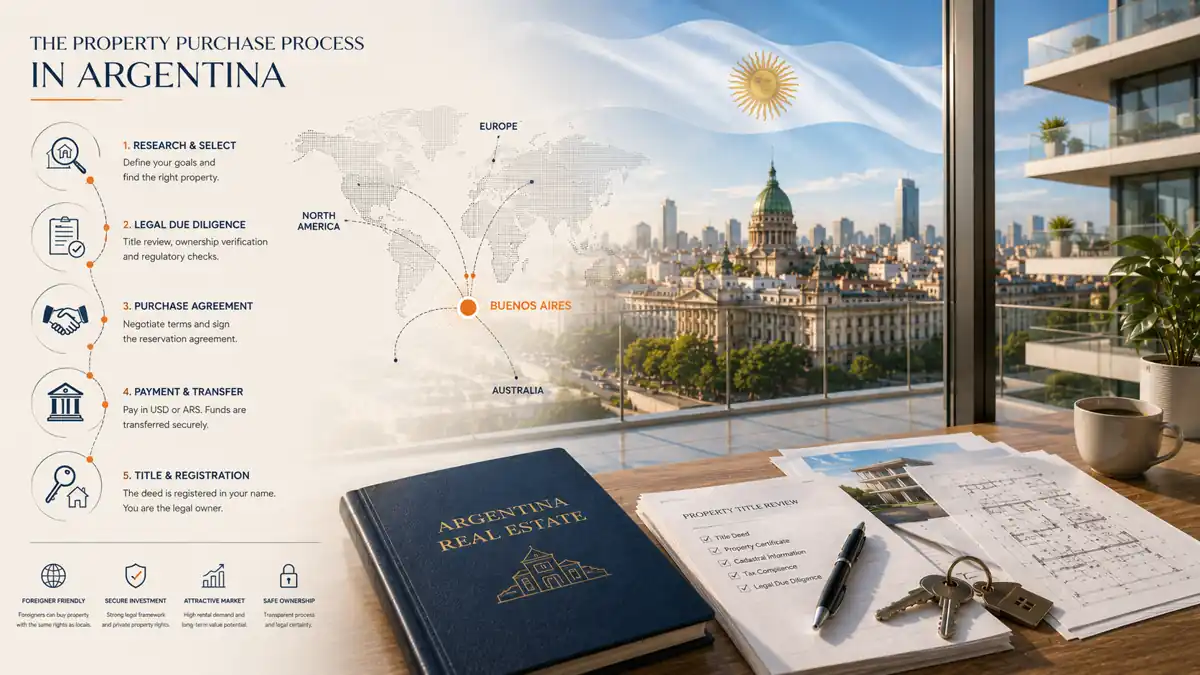
Step 1. Get a Tax Identification Number (CUIT)
Before any transaction can proceed, foreign buyers must obtain a tax identification number in Argentina. Non-residents without a DNI usually apply for a CUIT. This number is required for property purchases and related registrations. A local lawyer can assist with the application, or it can be done in person through ARCA, Argentina’s Federal Tax Agency.
Step 2. Choose the Right Location in Argentina
Argentina’s capital, Buenos Aires, remains the top choice for foreign buyers, thanks to its mix of European charm, dynamic neighborhoods, and affordability. Popular districts such as Recoleta, Palermo, Puerto Madero, and Barrio Norte offer high rental demand, architectural elegance, and strong resale value. When selecting a property, consider:
- Proximity to major avenues like Santa Fe or Callao, which affect price and accessibility
- Safety and infrastructure in the surrounding area
- Development trends, such as new construction projects or public works
- Building condition and potential maintenance liabilities
- Access to amenities such as parks, transport, and schools
A professional real estate advisor can provide market insight and often give access to off-market listings or units with better value.
Step 3. Make an Offer and Sign a Reservation (Reserva)
Once you’ve found a suitable property, the next step is to make a formal offer. This is done through a “Reserva,” a preliminary agreement that outlines the proposed purchase terms. The buyer deposits roughly 1% of the purchase price as a gesture of good faith. During this period, the seller is legally barred from accepting other offers.
If the buyer backs out without cause, the deposit is forfeited. If the seller defaults, they are typically required to return double the amount. It’s recommended to review the wording of the agreement with a lawyer before signing.
Step 4. Sign the Purchase Agreement (Boleto de Compraventa)
Once both parties agree on the sale terms, they move to the Boleto de Compraventa, a formal contract detailing the property description, price, payment schedule, and obligations. At this stage, the buyer typically pays 30–50% of the total price.
While this contract does not transfer ownership, it legally binds both sides. If the seller becomes insolvent, the buyer can still enforce the sale through the courts.
Step 5. Finalize Ownership with the Title Deed (Escritura Pública)
The transaction is concluded with the signing of the Escritura Pública, the official Title Deed, before a public notary (escribano). The notary performs due diligence, verifying the seller’s legal ownership, checking for outstanding debts or encumbrances, and registering the transaction with the Registro de la Propiedad (Real Estate Registry).
At this point, the remaining balance is paid, and the keys are handed over, transferring possession. Legal ownership is only fully recognized once the property is recorded in the registry.
Real Estate Buying Tips for Foreign Buyers in Argentina
If you're a foreigner planning to buy rural property in Argentina, there are important legal restrictions and steps to follow. Based on insights from the Golden Harbors Team, here are four key tips to help you navigate the process smoothly and legally:
Understand the Legal Framework Before You Buy
Before committing to any rural property, make sure you understand the legal framework under Law 26.737. This law governs foreign ownership of rural land and aims to preserve national resources. It applies not only to individuals but also to companies where the majority of shareholders are foreigners. Being aware of the law from the outset helps you avoid investing time and money in properties you may not be legally allowed to own. Our lawyers can assist you navigate this with ease.
Avoid Restricted Zones for Foreign Buyers
Certain areas are completely off-limits to foreign buyers. These include lands near national borders and properties with or close to significant water sources, due to national security and resource protection concerns. Make sure to verify the location of any property to ensure it doesn’t fall under these restricted zones.
Check for Residency-Based Exceptions
Some foreigners are exempt from the standard ownership restrictions. For example, if you've lived continuously in Argentina for 10 years, have an Argentine child and 5 years of residence, or have lived with or are married to an Argentine citizen for 5 years with permanent residency, you may be eligible to buy rural land without the usual limitations.
Obtain the Required Certificate Before Purchase
To complete a rural land purchase as a foreigner, you must apply for a special certificate from the National Rural Land Registry. The application is submitted online with supporting documents, and a fee of 0.1% of the property's value is required. This certificate is valid for 120 days from the date of issuance. If not used in time, penalties may apply.
Frequently Asked Questions About Buying Property in Argentina
Is Buying Property in Argentina a Good Investment?
Yes. Property in Argentina is increasingly seen as a contrarian but compelling investment as the market emerges from a prolonged downturn. With real estate prices still significantly undervalued in USD terms, down 30–40% from their peaks in many areas, buyers are re-entering in anticipation of a cyclical rebound. Political risk and currency volatility remain concerns, but for long-term investors willing to navigate bureaucracy and hold through macroeconomic swings, Argentina offers unique upside: high rental demand in key cities like Buenos Aires and Córdoba, low entry prices, and growing interest from lifestyle buyers and remote workers. According to Reuters, even Argentina’s dormant mortgage market is reactivating for the first time in years, further signaling a shift toward normalization.
Do You Need Residency to Buy Property in Argentina?
No, you do not need to be a resident to purchase real estate in Argentina. Foreigners enjoy the same rights as Argentine citizens under the constitution and can freely buy property, provided they obtain a CUIT, a foreigner’s tax identification number, and appoint a local representative for tax matters.
Can US Citizens Buy Property in Argentina?
Yes, U.S. citizens can buy real estate in Argentina with no residency or citizenship required, enjoying nearly the same rights as Argentine nationals.
Do You Need a Real Estate Agent to Buy Property in Argentina?
Absolutely not, you don’t need to hire a real estate agent to buy property in Argentina, but having one can make the process smoother and help avoid missteps. Legally, all you need is your passport, a CUIT (tax ID), and a licensed escribano (notary) to manage the transaction and verify clear title. That said, real estate agents typically handle property searches, negotiations, and local regulations, and they charge around 3–4% of the purchase price (plus VAT). Many expats strongly recommend working with an experienced local agent, especially when navigating language barriers and norms, although some buyers choose to go solo to avoid the commission.
How Much Does Property Cost in Argentina?
The average cost of residential property in Argentina varies significantly by region, but buyers can generally expect to pay around USD 2,300–2,500 per square meter in Buenos Aires, where a standard 60 m² apartment often ranges between USD 140,000 and USD 160,000 depending on the district and building quality. In upscale neighborhoods such as Palermo or Recoleta, prices frequently exceed USD 3,000/m² and may reach USD 4,500/m² in premium developments. In secondary cities such as Córdoba or Mendoza, residential prices are generally more affordable, averaging approximately USD 1,100–1,800/m². Despite the market recovery in 2025–2026, Argentina’s real estate sector is still considered relatively attractive for foreign buyers holding USD due to historically lower valuations compared to many international property markets.
Do You Need a Bank Account to Buy Property in Argentina?
Yes, it’s possible, but not mandatory, to open an Argentine bank account before buying property, and many buyers opt to do so for convenience. Legally, foreign purchasers only need a CUIT (tax ID) and can transfer funds from abroad via wire or reputable bureaux de change, though this can add 2–4% in fees and exchange costs.
Do You Pay Property Tax in Argentina?
Property owners in Argentina are subject to several taxes and transaction-related costs, although the effective burden remains relatively moderate compared to many Western jurisdictions. Annual property taxes, including the ABL tax in Buenos Aires, are calculated based on the property’s fiscal value rather than full market value, which is often substantially lower. In practice, annual property taxes for residential real estate commonly amount to approximately 0.1%–0.3% of the property’s market value, depending on the province, municipality, and property classification.
When purchasing or selling property, transaction costs generally include stamp tax (Impuesto de Sellos), usually ranging from around 1.5% to 3.6% depending on the jurisdiction, along with notary and registry fees. In Buenos Aires City, the standard stamp tax rate for property transfers is currently 3.6% of the declared sale price, commonly split between buyer and seller.
In addition, Argentine tax residents, and in certain cases non-residents with Argentine assets, may be subject to Bienes Personales (Personal Assets Tax), Argentina’s wealth tax regime. Depending on residency status and asset structure, applicable rates generally range between 0.5% and 1.5%, with reforms gradually reducing the higher brackets through 2026.
Can Buying Property in Argentina Lead to Residency?
No, owning property in Argentina does not automatically grant you residency or citizenship. It’s a separate legal journey, while foreigners can freely purchase real estate with a CUIT (tax ID) and a licensed notary, they must apply for residency through established visa categories, such as work visa, passive‑income (Rentista visa), retirement visa, or investor/business visas.
Good news that Argentina is moving ahead with a new Citizenship‑by‑Investment (CBI) program proposing full citizenship for foreign investors committing at least USD 500,000 to qualifying economic projects (e.g., agribusiness, energy, tourism) instead of passive real estate purchases.
There are Always Options to EXPAND YOUR BOUNDARIES! Let's Discuss Yours
Every client is unique
Every case requires an individual approach and solution. Our years of experience in the industry allow us to provide both.
We will answer all your questions and provide detailed information about the available second passport and residency programs to help you make the right choice.
Victoria
Lead Attorney at Golden Harbors

Victoria
Lead Attorney at Golden Harbors
Read also

