Singapore Business Visa

Offshore services
Bundled Services
Top Citizenship & Residency
Articles & Research
About Us
Contact Us


.svg)


Trusted by Global Clients & Partners


July 24, 2026
6
min read

Vanuatu vs Grenada Citizenship 2026: Cost, Mobility, and Speed Compared

.svg)


1.1K

1.1K
Key Takeaways
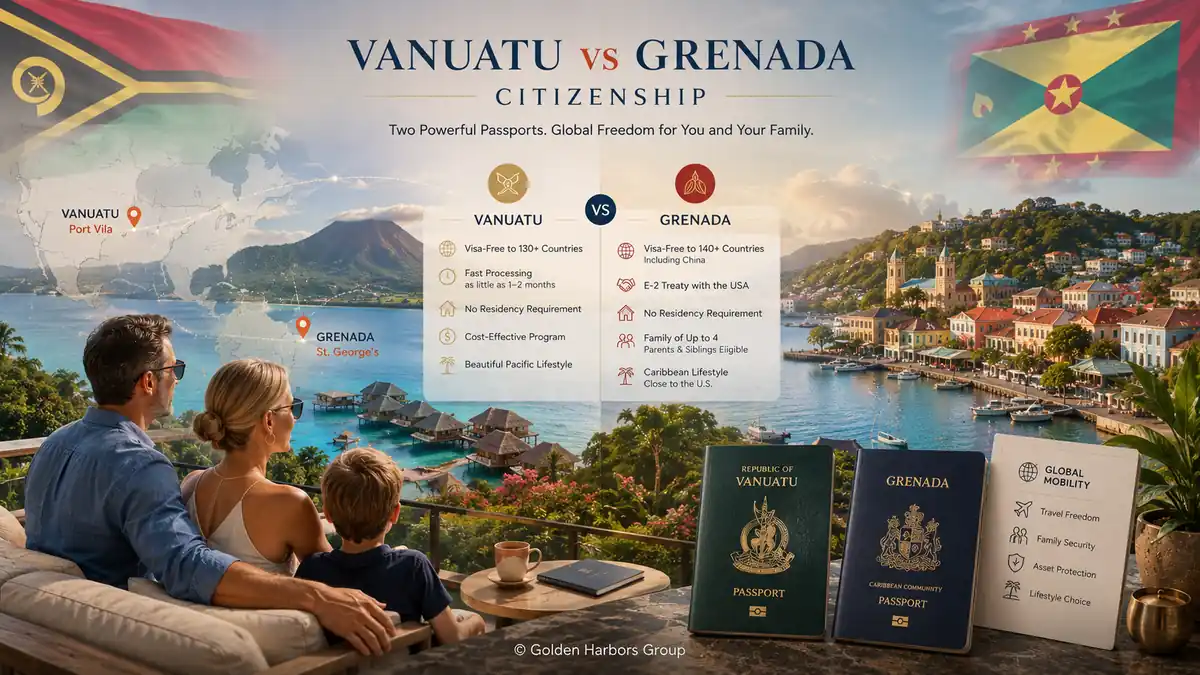
- Grenada is the stronger passport in 2026 with 147 visa-free or visa-on-arrival destinations (Henley 2026) including the UK, the Schengen Area, China, and Singapore. Vanuatu sits at roughly 88 destinations after the EU permanently terminated its Schengen visa-waiver agreement on December 12, 2024.
- Vanuatu remains the world's fastest CBI program at 30 to 60 days for approval in principle, versus a 6-month target for Grenada. End-to-end timelines run 2 to 4 months for Vanuatu against 5 to 7 months for Grenada under the incoming ECCIRA framework.
- Vanuatu's minimum investment is USD 130,000 (DSP, single applicant); Grenada's NTF route starts at USD 235,000 for a family of four. Grenada's real estate route requires USD 270,000 fractional or USD 350,000 sole ownership plus a USD 50,000 government contribution.
- Grenada is the only Caribbean CBI with a US E-2 Investor Visa Treaty (in force since 1989), giving Grenadian citizens a route to US business mobility after 3 years of domicile. No Pacific or Caribbean CBI alternative offers this access.
- ECCIRA's 30-day Grenada residency requirement is grandfathered: as of July 2026, applications lodged before the residency rule activates (targeted mid-2026) bypass it entirely, making the current filing window a live consideration for minimum-footprint applicants.
Quick Facts: Vanuatu vs Grenada 2026
Grenada citizenship by investment in 2026 wins on mobility and program credibility (147 visa-free destinations, US E-2 Treaty access, ECCIRA oversight), while Vanuatu wins on speed and cost (USD 130,000 minimum, 30 to 60 day approval). The European Union permanently terminated Vanuatu's Schengen visa-free access on December 12, 2024, reshaping the comparison entirely.
Which CBI Wins on Mobility, Speed, and Cost in 2026?
Vanuatu and Grenada both grant a recognized second citizenship in under 12 months, both permit dual citizenship, both impose no income tax, and both can be applied for remotely up to the biometric capture step. Beyond those structural similarities, they are competing on different axes in 2026, and the right choice depends on which axis matters most to the applicant.
Mobility Goes to Grenada
The Grenadian passport opens 147 visa-free or visa-on-arrival destinations including the UK, the Schengen Area, China, Russia, Hong Kong, and Singapore, ranking 27 on the 2026 Henley Passport Index. The Vanuatu passport opens approximately 88 destinations. The gap widened sharply when the European Union permanently terminated Vanuatu's Schengen visa-waiver agreement on December 12, 2024, and the United Kingdom reinstated visa requirements for Vanuatu passport holders in July 2023.
Speed Goes to Vanuatu
Vanuatu remains the fastest mainstream citizenship by investment program in the world. Approval in principle typically arrives within 30 to 60 days of complete submission, and the end-to-end timeline including biometrics and passport issuance runs 2 to 4 months. Grenada targets 6 months from complete submission to passport, lengthening to 5 to 7 months once the new ECCIRA biometric capture and applicant interview steps activate in mid-2026.
Cost Goes to Vanuatu
A single applicant under Vanuatu's Development Support Program contributes USD 130,000 non-refundable. A family of 4 contributes USD 180,000. Grenada's National Transformation Fund route starts at USD 235,000 for a family of 4, before counting the application, due diligence, processing, interview, and passport fees that add another USD 12,000 to USD 18,000 depending on family size. The real estate routes diverge less: Vanuatu starts at USD 200,000, Grenada at USD 270,000 fractional or USD 350,000 sole, both with a 5-year hold.
The Unique Feature: US E-2 Access
Grenada uniquely offers a path to the United States E-2 Investor Visa. Grenada signed an E-2 treaty with the US in 1989 and remains the only Caribbean CBI program with this access. After 3 years of continuous Grenadian domicile, a citizen becomes eligible to apply for the non-immigrant E-2 visa, which permits living and operating a business in the US and is renewable indefinitely as long as the underlying US business continues. No Vanuatu route delivers this. For investors planning eventual US business operations, this single feature can override every other comparison axis.
Why Did the EU Suspend Vanuatu's Visa-Free Access?
The European Union's decision to first suspend (March 3, 2022) and then permanently terminate (December 12, 2024) Vanuatu's Schengen visa-waiver agreement is the single most consequential event in CBI mobility over the past decade. Understanding the reasoning matters because it shapes the credibility risk that future Caribbean CBI programs face under similar EU scrutiny.
The Original Council Concerns
The EU Council's 2022 review identified four core issues with Vanuatu's pre-reform program. First, the granting of citizenship to applicants whose names appeared in Interpol databases. Second, an extremely low rejection rate that the Council viewed as evidence of insufficient due diligence rigor. Third, the nationalities of approved applicants frequently included citizens of countries whose nationals require a visa to enter the EU, creating a direct visa-policy circumvention concern. Fourth, the absence of any residency requirement, very fast processing, and limited information-sharing with applicants' countries of origin.
Vanuatu's 2024 Reforms
Between 2022 and the December 2024 final termination, Vanuatu reformed its program substantially. Mandatory biometrics were introduced (effective July 2025). Due diligence fees were raised to USD 5,500 (DSP) and USD 8,000 (CIIP) to fund deeper screening. Restricted nationalities were tightened to exclude applicants from Iran, Iraq, North Korea, Syria, and Yemen. E-passports with ICAO-compliant biometric chips were rolled out in December 2024. The Vanuatu Citizenship Office and Commission and Financial Intelligence Unit established formal cooperation protocols with international law enforcement.
Why the Reforms Did Not Restore Access
The EU Council's December 2024 final decision concluded that the structural features of investor citizenship, particularly the short residency footprint, the speed of issuance, and the financial-investment qualification path itself, remained incompatible with the visa-waiver framework regardless of operational improvements. The implication for the broader CBI industry is that programs offering rapid citizenship without genuine residency exposure now face a structural ceiling on EU mobility, not merely a due diligence ceiling.
What This Means for Grenada
Grenada has retained Schengen visa-free access through 2025 and into 2026. The European Commission has signaled ongoing scrutiny of all Caribbean CBI programs but has not initiated formal suspension proceedings against any. ECCIRA's introduction of a 30-day residency requirement, biometric capture, and applicant interviews is widely understood as the OECS regional response to EU concerns, designed to maintain Schengen access by demonstrably tightening program integrity.
What Does Each Program Cost in 2026?
The headline contribution figures tell only part of the story. The full all-in cost depends on family composition, route selection, government fees layered on top of the qualifying investment, and the redeemable versus non-refundable nature of each contribution. The table below frames the comparison across the most common applicant profiles.
← Swipe →
| Cost Component | Vanuatu DSP | Grenada NTF | Notes |
|---|---|---|---|
| Single applicant | USD 130,000 | USD 235,000 (family of 4 base) | Vanuatu prices per applicant; Grenada NTF base covers up to 4 |
| Family of 2 (couple) | USD 150,000 | USD 235,000 | Grenada base accommodates couples within family-of-4 pricing |
| Family of 3 | USD 165,000 | USD 235,000 | Grenada more cost-efficient as family size approaches 4 |
| Family of 4 | USD 180,000 | USD 235,000 | USD 55,000 absolute difference at family of 4 |
| Additional dependent (standard) | USD 15,000 per person | USD 25,000 per person | Both programs add per-person fees beyond base |
| Due diligence fee | USD 5,500 (one-time) | USD 5,000 per applicant 17+ | Grenada scales with family size; Vanuatu is flat |
| Application fee | Included in contribution | USD 1,500 per person | Grenada itemizes; Vanuatu bundles |
| Passport issuance | USD 800 per adult | USD 350 adult / USD 250 minor | Vanuatu higher per-passport; Grenada lower |
| Biometric fee | From USD 1,000 per person | Included in ECCIRA framework | Vanuatu fees vary by submission location |
| Asset proof requirement | USD 250,000 | Not formally required | Vanuatu requires asset documentation |
| Refundable component | None (DSP); USD 50,000 (CIIP) | None on NTF route | CIIP holds USD 50,000 in CNO Future Fund 4 to 5 years |
| Real estate alternative | USD 200,000 (5-year hold) | USD 270,000 fractional / USD 350,000 sole + USD 50,000 | Both real estate routes carry 5-year holds |
| Source: Vanuatu Citizenship Office and Commission fee schedule 2026; Investment Migration Agency (IMA) Grenada fee schedule 2026; Grenada Citizenship by Investment Act 2013 as amended; OECS Memorandum of Agreement July 2024. Figures exclude legal and authorized agent fees, which are quoted on engagement. ECCIRA-driven fee adjustments expected mid-2026. | |||
How Does Visa-Free Travel Compare?
The mobility comparison is where the two programs have diverged most sharply since 2024. The Grenadian passport has held its position near the top quartile of global mobility rankings, while the Vanuatu passport dropped roughly 30 destinations after the EU Schengen termination. The table below shows the current state of access for both passports across the highest-demand jurisdictions.
| Destination | Vanuatu Passport | Grenada Passport |
|---|---|---|
| EU Schengen Area (29 countries) | Visa required (terminated December 12, 2024) | Visa-free, up to 90 days in any 180 |
| United Kingdom | Visa required (since 2023) | Visa-free, up to 6 months |
| Ireland | Visa required | Visa-free, up to 90 days |
| Singapore | Visa-free, up to 30 days | Visa-free, up to 30 days |
| Hong Kong | Visa-free, up to 90 days | Visa-free, up to 90 days |
| China (mainland) | Visa required | Visa-free, up to 30 days |
| Russia | Visa-free, up to 90 days | Visa-free, up to 90 days |
| UAE | Visa-on-arrival | Visa-on-arrival |
| Malaysia, Thailand, Indonesia, Philippines | Visa-free for most | Visa-free for most |
| Caribbean and CARICOM | Visa-free for most | Visa-free for all CARICOM (member benefit) |
| Latin America (Argentina, Brazil, Chile) | Visa-free for most | Visa-free for most |
| United States | Visa required (B1/B2 visitor) | Visa required (B1/B2 visitor); E-2 path after 3 years |
| Canada | Visa required | Visa required (eTA path under negotiation) |
| Australia | ETA required | ETA required |
| Total visa-free destinations | ~88 destinations (Henley 2026) | 147 destinations (Henley 2026, rank 27) |
| Source: Henley Passport Index 2026; Council of the European Union decision of December 12, 2024 (terminating Schengen visa-waiver agreement with Vanuatu); UK Home Office visa policy updates; CARICOM Single Market and Economy member-state list. Visa-free durations and conditions vary by destination; verify entry requirements with the destination country before traveling. | ||
How Long Does Each Program Take?
Both programs are processed entirely through licensed agents (no direct applications), but the timeline structure differs meaningfully. Vanuatu prioritizes throughput speed; Grenada prioritizes due diligence depth. The biometric requirement applies to both and adds a fixed logistics component to either timeline.
Vanuatu Timeline: 30 to 60 Days Approval, 2 to 4 Months End to End
The Vanuatu Financial Intelligence Unit (FIU) runs the due diligence in roughly 3 to 8 working days. Approval in principle typically arrives within 30 to 60 days of complete submission. Within the 90 days following approval, the applicant wires the qualifying contribution. Biometric capture happens at one of five approved locations (Port Vila plus the Vanuatu missions in Brussels, Dubai, Hong Kong, and Nouméa) and typically adds 1 to 3 weeks depending on travel logistics. Naturalization, ID card, and biometric e-passport issuance complete in a further 2 to 4 weeks. Total end-to-end: 2 to 4 months from initial submission for most files.
Grenada Timeline: 6 Months Target, 5 to 7 Months Under ECCIRA
The Grenada Investment Migration Agency (IMA) targets a 6-month total processing window from complete submission to passport issuance. The first phase (due diligence plus approval in principle) runs about 10 to 12 weeks. The second phase (qualifying investment, final approval, passport issuance) adds another 6 to 8 weeks. From mid-2026 forward, ECCIRA introduces mandatory biometric capture and applicant interviews, adding an estimated 2 to 4 weeks during the regulator's initial operating period as systems and personnel are deployed.
When Speed Actually Matters
The 4-to-5-month gap matters most for applicants navigating jurisdiction-change deadlines (tax residency cutoffs, banking compliance windows, expatriation timelines) or for those whose primary passport is becoming materially less useful in the near term. For applicants with stable home-country status who can plan over a 6-to-12-month window, the speed differential is largely cosmetic, and the mobility differential dominates the choice.
Which Investment Routes Does Each Country Offer?
Vanuatu offers three investment routes (DSP, CIIP, REO) and Grenada offers two (NTF, real estate). The structural difference is that one of Vanuatu's routes (the CIIP) includes a partially refundable component, while Grenada's NTF is fully non-refundable and its real estate route requires a separate USD 50,000 non-refundable government contribution on top of the property purchase.
← Swipe →
| Route | Country | Minimum | Mechanism |
|---|---|---|---|
| DSP (Development Support Program) | Vanuatu | USD 130,000 single; USD 180,000 family of 4 | Non-refundable contribution to the National Development Fund. The most widely used route, with the standardized timeline and document set. |
| CIIP (Capital Investment Immigration Plan) | Vanuatu | USD 165,000 flat (1 to 4 applicants) | USD 115,000 non-refundable plus USD 50,000 to the CNO Future Fund, redeemable after 4 to 5 years subject to fund performance. Lower net cost for families of 3 or 4. |
| REO (Real Estate Option) | Vanuatu | From USD 200,000 | Investment in approved projects on Efate or Espiritu Santo. Narrow project selection. 5-year hold typical. |
| NTF (National Transformation Fund) | Grenada | USD 235,000 family of 4 base | Non-refundable donation to the government fund supporting infrastructure, healthcare, education, and renewable energy. Additional dependents at USD 25,000 each. |
| Real estate (fractional) | Grenada | USD 270,000 + USD 50,000 government contribution | Fractional ownership in pre-approved tourism-sector property (hotels, resort residences). 5-year hold. Potentially resaleable to the next CBI applicant. |
| Real estate (sole) | Grenada | USD 350,000 + USD 50,000 government contribution | Sole ownership of a pre-approved development. Same 5-year hold and resale mechanics as fractional. |
| Source: Vanuatu Citizenship Office and Commission program documentation; CNO Future Fund disclosures (Vanuatu); Investment Migration Agency (IMA) Grenada program rules 2026; Grenada CBI Act 2013 as amended. The CIIP redemption depends on the CNO Future Fund's performance and program terms in effect at redemption. | |||
How Does ECCIRA Change Grenada in 2026?
The Eastern Caribbean Citizenship by Investment Regulatory Authority (ECCIRA) is the most consequential regulatory development in Caribbean CBI in over a decade. Established by the five OECS CBI nations under the July 2024 Memorandum of Agreement and ratified by all five member states, ECCIRA is headquartered in Grenada and becomes operational in 2026, with an initial operating date targeted for April 2026 and full activation widely expected by June 2026. It replaces the previous patchwork of country-specific standards with a binding regional rulebook.
Six Changes Coming Under ECCIRA
First, a harmonized USD 200,000 minimum investment floor across all five OECS programs. Grenada's current USD 235,000 NTF and USD 270,000 real estate thresholds already exceed this floor, so Grenada pricing does not drop. Second, mandatory biometric data collection (fingerprints, facial recognition, digital signature) at application stage and at passport renewal for existing holders. Third, mandatory applicant interviews for every principal applicant and dependent over 16, conducted in person or by secure video link. Fourth, annual application caps set yearly by ECCIRA, constraining throughput in years where regional volumes exceed sustainable levels.
Fifth, a 30-day residency requirement within the first 5 years after passport issuance. The main applicant must spend at least 5 days in Grenada within the first 12 months, with the remaining 25 days allocated across the family and the following 4 years. Holiday, business, medical, and study trips all count. Sixth, initial passport validity drops to 5 years with renewal contingent on demonstrated compliance with the residency requirement.
The Grandfathering Window: Why Timing Matters Now
As of July 2026, the 30-day residency requirement is grandfathered. Applications lodged with the IMA before the residency rule activates (targeted mid-2026, following its earlier postponement) are processed under the existing framework with no physical-presence commitment. Applications lodged after activation carry the full 30-day obligation. For high-net-worth applicants prioritizing minimum-footprint citizenship, this creates a live filing window: the same Grenadian citizenship, but without the residency commitment, remains available to files submitted before the cutoff. Applicants weighing Grenada against Vanuatu on the residency-footprint axis should treat this window as a decision input, not a background detail.
Implications for the Vanuatu Comparison
ECCIRA narrows the operational difference between Caribbean and Pacific CBI in three ways. Biometrics, which Vanuatu already requires (effective July 2025), become standard for Grenada too. The 30-day residency requirement, while modest, ends Grenada's previous zero-residency status for post-cutoff files and aligns it directionally with the global movement toward genuine-link citizenship standards. The annual caps may create timing pressure for applicants wanting to file in oversubscribed years.
Which Program Should You Choose for Your Profile?
The right choice in 2026 depends on which of five drivers ranks first in the applicant's decision matrix. Once that priority is clear, the selection logic usually resolves cleanly.
Choose Vanuatu When Speed and Budget Dominate
Vanuatu is the right answer when the applicant needs a recognized second passport in under 4 months for jurisdiction-change reasons, when the budget ceiling is below USD 200,000, when the visa-free mobility priorities sit in Asia-Pacific (Singapore, Hong Kong, Malaysia, Russia) rather than Europe, when the family is small (single applicant or couple, where Vanuatu pricing is most competitive), or when the applicant is a non-EU and non-UK resident for whom Schengen access is not a primary mobility need.
Choose Grenada When Mobility and US Access Dominate
Grenada is the right answer when the applicant prioritizes maximum global mobility (the roughly 60-destination gap is decisive), when Schengen and UK visa-free access matter, when the applicant intends to eventually access the United States through the E-2 Investor Visa pathway (the single largest premium feature in Caribbean CBI), when the family is mid-sized (3 to 4 members, where Grenada pricing is most competitive within the family-of-4 base), or when the applicant can file within the pre-ECCIRA grandfathering window to secure citizenship without the 30-day residency commitment.
Sergey Voinich, Founder and Managing Partner at Golden Harbors, notes: "The mistake we see most often is treating this as a pure price comparison. The applicants who choose well start from where they actually want to travel and whether the US E-2 route is on their horizon, then let cost fall out of that, not the other way around."
When Neither Fits Cleanly
Applicants whose priority profile splits across the two (high mobility need plus budget ceiling, or fast timeline plus US access aspiration) should evaluate alternative routes. The St. Kitts and Nevis program offers stronger passport mobility than Grenada with similar pricing but no E-2 access. The Antigua and Barbuda program offers a lighter residency variant that may suit applicants reluctant about ECCIRA's 30-day commitment. The Maltese citizenship path offers EU citizenship outright but at a far higher pricing tier with a multi-year residency commitment. See our Grenada CBI deep-dive and Vanuatu CBI deep-dive for full route-by-route detail, or compare the wider field in our cheapest CBI programs guide.
Frequently Asked Questions
Is Vanuatu Citizenship Still Worth It Without Schengen Access?
Yes, for the right profile. Vanuatu retains visa-free access to roughly 88 destinations including Singapore, Hong Kong, Malaysia, Russia, the Caribbean, and most of Oceania. The program also keeps its speed (30 to 60 day approval) and price advantage (USD 130,000 single applicant). For applicants prioritizing Asia-Pacific mobility, tax neutrality, and rapid issuance over European access, Vanuatu remains competitive.
Why Is Grenada the Only Caribbean CBI With US E-2 Treaty Access?
Grenada and the United States signed an E-2 Investor Visa Treaty in 1989. None of the other Caribbean CBI nations (St. Kitts, Antigua, Dominica, St. Lucia) hold E-2 treaties with the US. Grenadian citizens become E-2-eligible after 3 years of continuous Grenadian domicile. The E-2 permits living and operating a US business and renews indefinitely as long as the business remains operational.
Can Both Programs Be Held Simultaneously?
In principle yes, but it is rarely useful. Both Vanuatu and Grenada permit dual or multiple citizenships. An applicant could theoretically hold both passports plus their original citizenship. In practice, the operational overlap between the two passports is limited, and the cost of acquiring both (approximately USD 365,000 in qualifying investment alone) typically exceeds the marginal benefit over choosing one well-suited program.
Do Both Programs Allow Family Inclusion?
Yes, but with different family scopes. Vanuatu includes spouses, children up to 25, and financially dependent parents over 50. Grenada includes spouses, children under 30 (those 18 to 29 must be financially dependent), parents and grandparents of either spouse, and unmarried dependent siblings. Grenada's three-generation family inclusion is one of the broadest in the CBI industry.
Does Either Program Require Me to Live There?
Vanuatu has no residency requirement at any stage. Grenada has had no residency requirement historically but introduces a 30-day requirement within the first 5 years after passport issuance under ECCIRA from mid-2026. Files lodged before that rule activates are grandfathered without the commitment. The 30-day requirement, where it applies, can be allocated across multiple visits and includes any travel purpose (holiday, business, medical, study).
Which Program Has Better Tax Treatment?
Both programs are tax-neutral on the citizenship side. Neither country taxes worldwide income, capital gains, inheritance, or wealth for non-resident citizens. Vanuatu relies on VAT (15 percent) and customs duties; Grenada operates a territorial system taxing only Grenada-source income. Citizenship alone does not change an applicant's home-country tax residency in either case. Tax planning depends on physical relocation, not passport choice.
How Golden Harbors Helps
Golden Harbors advisors handle both Vanuatu and Grenada CBI mandates from initial profile assessment through passport issuance. The selection framework begins with the applicant's mobility priorities, timeline constraints, budget ceiling, family structure, and downstream goals (US E-2 access, EU residency, tax restructuring). For applicants leaning toward Vanuatu, we coordinate directly with licensed designated agents in Port Vila, structure the source-of-funds documentation before submission, handle the FIU due diligence response, and book biometric appointments at the optimal location for the applicant's travel schedule.
For applicants leaning toward Grenada, we work through Authorized Local Agents in St. George's, manage the IMA submission and 10-to-12-week due diligence response, conduct independent project-level due diligence on approved real estate developments where relevant, and structure the ECCIRA timing strategy for applicants who want to file within the pre-activation grandfathering window. For families considering the E-2 pathway on top of Grenadian citizenship, we coordinate the 3-year domicile build, US business structuring, and E-2 application timing as a single integrated workstream.
For applicants whose profile genuinely splits across the two programs, we run a side-by-side decision analysis covering all five drivers (mobility, speed, cost, family fit, downstream goals) and surface the alternative options where neither pure choice fits. See Grenada citizenship or our broader CBI program library for full scope coverage.
You have read the comparison; now build the plan. Book a general consultation call with Golden Harbors, global mobility experts who walk you through the right Vanuatu or Grenada route, ECCIRA grandfathering timing, and the trade-offs that matter for your specific mobility, family, and tax profile.
Book a CallAbout the Author
Sergey Voinich, Founder and Managing Partner at Golden Harbors, is a foreign attorney specializing in international, patent, and copyright law, with over 20 years of experience across CIS finance and US technology sectors. He has held roles at PayPal, eBay, and Amazon and is certified by the Investment Migration Council. At Golden Harbors, he leads a team focused on global citizenship and residency solutions for entrepreneurs and family offices.
Last reviewed: July 2026.
Disclaimer: This article is for informational purposes only and does not constitute legal, tax, or immigration advice. Program terms, tax rates, and regulatory requirements change frequently. Verify current requirements before acting.
There are Always Options to EXPAND YOUR BOUNDARIES! Let's Discuss Yours
Every client is unique
Every case requires an individual approach and solution. Our years of experience in the industry allow us to provide both.
We will answer all your questions and provide detailed information about the available second passport and residency programs to help you make the right choice.
Victoria
Lead Attorney at Golden Harbors

Victoria
Lead Attorney at Golden Harbors
Read also

